Not ransomware, not an infostealer: a fake-installer campaign that rents out the victim's machine
Summary
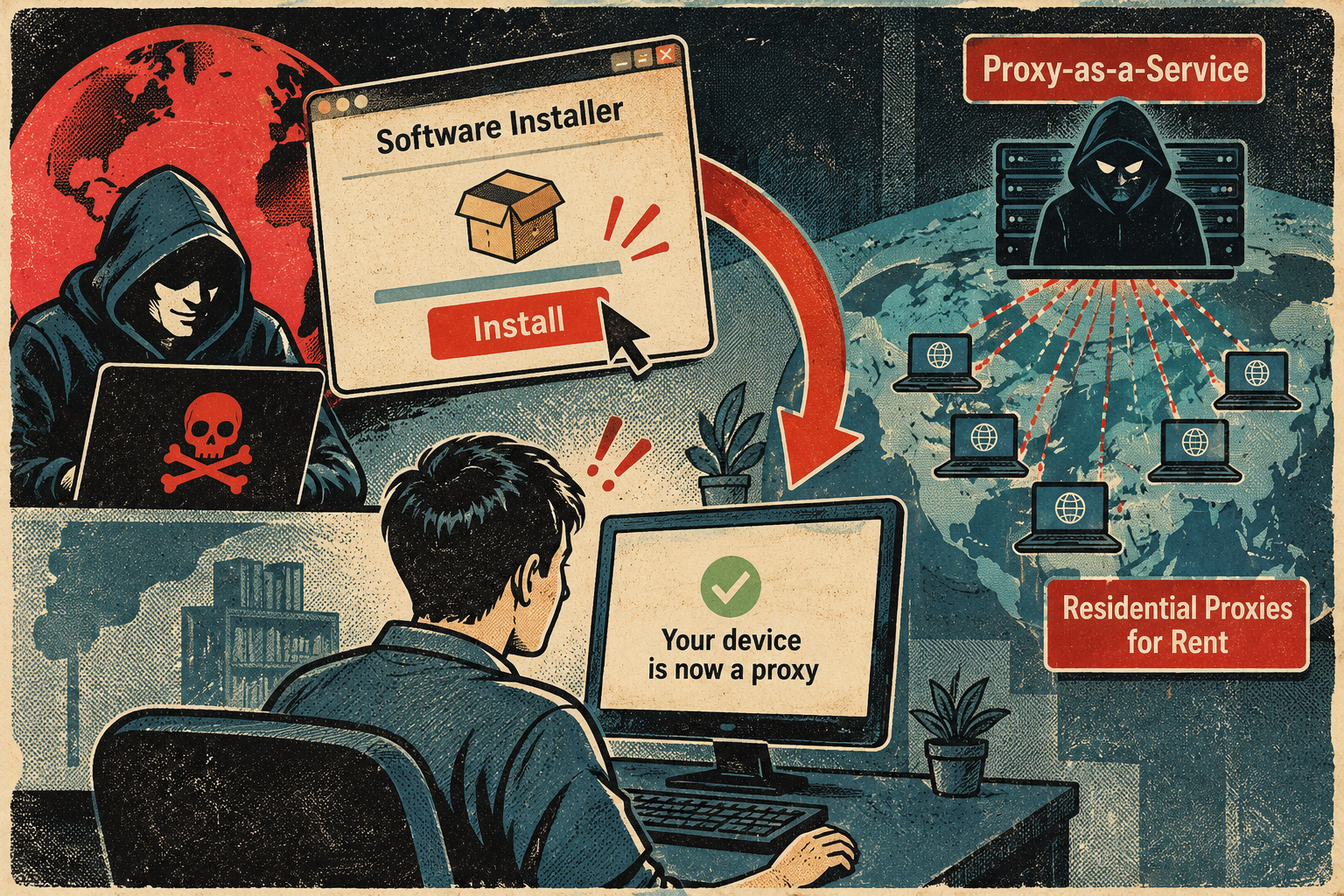
On November 3, 2026, Microsoft Security Research published a campaign distributing fake installers for cracked software, pirated games and unofficial utilities. Users run the installer, and what lands on the machine is not what they wanted.
What sets this campaign apart from most of what we have covered lately: the payloads are not infostealers, not miners, not ransomware. The three monetization branches are:
- Proxyware — WorldProxyPool routes third-party internet traffic through the victim's device
- Distributed computing — CharityEngine and BOINC, with VirtualBox, consume the device's compute resources
- Adware-style utilities — AW Manager and Windows Manager, with updater components The installation chain rests on an Inno Setup-style runner that executes several "offers" in one session, each with an independent outcome. Microsoft names no campaign, attributes to no actor, publishes no scale figures, and does not describe how victims find the fake download pages.
Priority actions:
- Review newly created SYSTEM-level scheduled tasks (Event ID 4698), especially the three named
WorldProxyPoolAgent,WorldProxyPoolWatchdogandWorldProxyPoolUpdater. Three tasks running as SYSTEM mean this chain reached administrative privileges on that host. - Audit software inventory for WorldProxyPool, CharityEngine, BOINC and VirtualBox across the fleet. But read the "Is this even malware?" section below before concluding anything — the presence of BOINC alone is not evidence of infection.
What the lures say about the victims
The list of impersonated software is worth reading carefully, because it sketches the target audience fairly precisely:
Cracked commercial software:  Navicat Premium, FabFilter Total Bundle,
                              cracked audio plugins
Free / pirated games:         Command & Conquer: Red Alert 2,
                              Deadpool Apunka Games
Game tooling:                 Roblox executors, auto-clickers
                              (Echo Client, Cue Club, Auto Clicker)
Driver and phone unlock:      TFT Unlock Tool
Activators, plugins, utils:   clownfishvoicechanger
These are three quite different populations: technical and music users hunting cracks of expensive tools, young users after Roblox tooling, and phone service shops after unlock utilities. The only thing they share is that they are all downloading software from unofficial sources.
Users run the installers from their Downloads folder, from archive-extraction folders, or from Inno extraction paths.
A gap worth stating: Microsoft describes the fake download pages as polished but does not say how users find them. There is no SEO poisoning, malvertising or YouTube evidence in the report. This post does not speculate on its behalf.
The infection chain
1. The user runs a fake installer

2. An Inno Setup-style runner unpacks into %TEMP%\is-*.tmp\
   and starts numbered stages: eld*.exe, set_*.exe

3. The runner calls back to C2 with:
      d=inno
      r=offer_execution        (or r=offer_execution_fail)
   plus offer, affiliate and download-network IDs
   -> those IDs determine which payloads are delivered
   Some child payloads launch before or around the callback

4. Payloads install silently using switches such as:
      /qn   /S   /quiet   /norestart
The offer/download-network pairs Microsoft observed:
o=1712/dn=507    o=1720/dn=536    o=1727/dn=564    o=1729/dn=566
o=331/dn=244     o=1674/dn=440    o=1675/dn=441    o=1681/dn=447
o=1730/dn=567
The offer architecture: why blocking one does not save the host
This is the shortest section here and probably the most important one operationally.
Each offer in the chain has an independent outcome. When antivirus blocks one stage, the runner sends r=offer_execution_fail to C2 and carries on with the remaining offers. It does not stop, does not roll back, does not treat the session as failed.
The practical consequence for a SOC: an antivirus verdict on a host does not mean the incident is handled. If you see Defender catch one stage and close the ticket there, the other offers in that same session may well have installed and be running. Each callback should be read as the result of one offer, not of the chain — exactly as Microsoft recommends: group by device and time window, then correlate with other activity.
The three monetization branches
1. Proxyware — WorldProxyPool. Routes third-party internet traffic through the victim's device. Put plainly: the victim's machine becomes a network exit point for strangers.
2. Distributed computing — CharityEngine and BOINC. Consumes the device's compute resources. Notably, VirtualBox is installed alongside — meaning this chain stands up an entire hypervisor on a user's machine.
3. Adware-style utilities — AW Manager and Windows Manager, with their own updater components.
Persistence
WorldProxyPool creates three SYSTEM-level scheduled tasks:
| Task name | Behavior | Frequency |
|---|---|---|
WorldProxyPoolAgent |
Runs sdk-agent.exe |
At startup, and immediately on install |
WorldProxyPoolWatchdog |
Runs a hidden PowerShell script | Every 5 minutes |
WorldProxyPoolUpdater |
Runs sdk-agent.updater.exe update |
Hourly |
It also writes uninstall metadata to the registry — an interesting detail, since outright malware rarely bothers creating an uninstall entry.
Evasion
- Masquerading under cracked-software or game names
- Hidden, non-interactive PowerShell execution
- Silent unattended installs with no user confirmation
- Rotating callback domains with randomized URL paths
- Independent offer outcomes: one failure does not stop the others
The fourth point is why the domain list in the IOC section will go stale faster than the behavioral indicators.
Is this even malware, and why the question matters
This is not a question of wording. It determines how you triage.
BOINC is a fully legitimate volunteer computing platform, developed at UC Berkeley and installed willingly by hundreds of thousands of people to contribute to research projects. Proxyware is a real business model: several services pay users to share bandwidth. VirtualBox is Oracle software.
What makes this campaign a problem is not the nature of the software but the way it is installed: silently, through an installer pretending to be something else, without the owner's informed consent. Microsoft frames it precisely there — the security and privacy risk comes from deceptive bundled installation, not from any of these products existing.
The pay-per-install model behind the o= and dn= parameters occupies the same grey zone: it is a real affiliate ecosystem where operators are paid per successful install, and the IDs let them reconcile results across distribution partners.
The practical consequence for a SOC, and this is the part to remember:
- The presence of BOINC on a machine is not, by itself, evidence of infection. Some people install it deliberately, for real reasons. Both Microsoft and the secondary coverage flag this explicitly.
- What confirms it is the installation chain, not the end product: the runner in
%TEMP%\is-*.tmp\, theeld*.exeorset_*.exestages, thed=innocallback, and WorldProxyPool's three SYSTEM scheduled tasks. - Domain matches are leads, not confirmation — Microsoft's own wording.
Assessment
The real enterprise risk of proxyware is not bandwidth. It is that your organization's IP address becomes an exit point for strangers' traffic. The consequences follow in a chain: abuse complaints to your ISP, the IP landing on blocklists and degrading your mail or public services, and in the worst case someone else's illegal traffic being traced back to your organization's IP range. That is legal and reputational exposure, not a performance problem.
Three SYSTEM-level scheduled tasks are a more serious signal than the campaign's surface appearance suggests. An ordinary "adware" chain cannot create SYSTEM tasks. That it happened means that at some point the installation chain held administrative privileges on that host — either the user was a local admin, or UAC was approved. On such a host, the scope of investigation should not stop at the three monetization branches.
The affiliate model makes attribution close to meaningless. Microsoft names no actor, and reasonably so: in a pay-per-install ecosystem, whoever builds the fake installer, whoever runs the distribution network, and whoever owns each individual offer can be three entirely separate parties. Hunting by group will not work. Hunting by behavioral chain will, which is why the is-*.tmp and d=inno indicators deserve priority over the domain list.
The VirtualBox detail deserves separate notice. A covert installation chain standing up a hypervisor on a user's machine is not ordinary, even if the purpose is only to run BOINC in isolation. It materially expands the host's attack surface, adds kernel-level drivers, and creates an execution environment that host-based monitoring sees very little of.
Writing uninstall metadata to the registry suggests this campaign considers itself legitimate. Outright malware rarely creates an uninstall entry. That small detail reinforces reading the whole operation as a grey-zone commercial activity rather than a classic cybercrime campaign — which does not make it less dangerous, but does change how you classify and handle it.
This report is strong on detection and thin on context. No campaign name, no attribution, no figures, no explanation of the distribution channel. It is a report written for operators rather than for threat analysts, and should be read with that expectation.
Relevance for Vietnam
- Microsoft publishes no geographic breakdown, or even a victim total. But the distribution channel needs no figures to assess relevance.
- Cracked software, activators and pirated games are an extremely common distribution channel in Vietnam, including inside corporate environments. Navicat Premium appearing among the lures is notable — it is a database administration tool, and whoever downloads a cracked copy of it typically has access to data systems.
- Roblox executors and auto-clickers point straight at personal machines and BYOD devices. If your organization lets personal devices reach internal resources, that is a path in that passes through none of IT's controls.
- TFT Unlock Tool points at phone service shops — a large segment in Vietnam, typically using shared machines with no EDR, and handling customers' devices.
- Proxyware on a Vietnamese corporate IP is far more serious than lost bandwidth. Picture explaining to your ISP, or to a regulator, that the traffic leaving your company's IP range was not generated by your company.
- Proxyware and distributed-computing traffic is easily misread as a performance issue — a slow machine, loud fans, unusual bandwidth outside working hours. Those symptoms get reported to the IT helpdesk, not to the SOC.
Recommendations
Detection and hunting
- Review newly created SYSTEM scheduled tasks via Event ID 4698, prioritizing WorldProxyPool's three. This is a cheap, specific, low-noise indicator.
- Look for processes executing from
%TEMP%\is-*.tmp\with names shaped likeeld<number>orset_<number>, plus runners namedFirstFastandSecondRunner. - Look for HTTP traffic containing
d=innowithr=offer_executionorr=offer_execution_fail. This is the campaign's most durable indicator, because it belongs to the mechanism rather than the infrastructure. - Read each callback as the result of one offer, grouped by device and time window. A host with multiple callbacks means multiple payloads, even if AV blocked some of them.
- Audit software inventory for WorldProxyPool, CharityEngine, BOINC and VirtualBox, then correlate each hit with the installation chain before concluding.
- Do not close the ticket just because AV caught one stage. The independent-offer architecture makes that the wrong conclusion.
Prevention
- Block and educate against cracked software, keygens and activators. The advice sounds tired, but for this campaign it is the only control that stops it at the source.
- Enable cloud-delivered protection, reputation-based protection and tamper protection in Defender; enable PUA protection too where the environment allows.
- Evaluate and deploy the ASR rules that fit your environment.
- Revisit BYOD policy if personal devices have a path to internal resources.
- Consider blocking software installation by non-admin users. The three SYSTEM scheduled tasks in this campaign exist only because the installation chain had administrative rights.
Defender Antivirus
Trojan:Win64/OfferLoader.DA!MTB
Trojan:Win64/OfferLoader.DB!MTB
Behavior:Win32/SuspInnoOffer.A!mapsi
Adware:Win32/Clover
Trojan:Win32/OffLoader.A
Defender for Endpoint alerts
Wacatac, Kepavll, Egairtigado, Clover,
SuspInnoOffer, SuspEtherRpcConn, SuspSmsScanConn,
suspicious scheduled task activity
MITRE ATT&CK
Mapping exactly as published by Microsoft.
| Tactic | Technique | How it appears here |
|---|---|---|
| Execution | T1204.002 — User Execution: Malicious File | The user runs the fake installer |
| Persistence | T1053.005 — Scheduled Task/Job: Scheduled Task | WorldProxyPool's three SYSTEM tasks |
| Defense Evasion | T1036 — Masquerading | Posing as cracked software and games |
| Defense Evasion | T1564.003 — Hide Artifacts: Hidden Window | Hidden PowerShell, silent installs |
| Command and Control | T1071.001 — Application Layer Protocol: Web Protocols | d=inno callbacks over HTTP |
| Command and Control | T1105 — Ingress Tool Transfer | Payloads fetched per offer |
| Impact | T1496 — Resource Hijacking | Proxyware and distributed computing |
T1496 is the technique that defines this campaign. Worth noting: Resource Hijacking is usually associated with cryptomining, but here it covers hijacking of bandwidth as well as compute — a broader reading that detection teams should weigh when building use cases.
IOCs
From the Microsoft Security Research report.
Domains in the IOC list
beliefdesk[.]xyz
companyharbor[.]xyz
signalpane[.]cfd
inkact[.]xyz
wishgrove[.]cfd
Additional domains (appearing in the report's hunting section)
orbittrack[.]cfd      prairielink[.]cfd     willowbox[.]xyz
stonestation[.]cfd    foldlodge[.]xyz       friendsanchor[.]xyz
fallport[.]cfd        wishcourt[.]cfd       cratebase[.]cfd
belieftrack[.]cfd
Callback pattern (more durable than the domain list)
d=inno
r=offer_execution
r=offer_execution_fail
Randomized URL paths, rotating domains

Observed offer/download-network pairs:
o=1712/dn=507   o=1720/dn=536   o=1727/dn=564   o=1729/dn=566
o=331/dn=244    o=1674/dn=440   o=1675/dn=441   o=1681/dn=447
o=1730/dn=567
Files and paths
%TEMP%\is-*.tmp\eld*.exe
%TEMP%\is-*.tmp\set_*.exe
C:\Program Files\WorldProxyPool\sdk-agent.exe
sdk-agent.updater.exe
Runners: FirstFast, SecondRunner
Scheduled tasks (SYSTEM)
WorldProxyPoolAgent        # sdk-agent.exe at startup
WorldProxyPoolWatchdog     # hidden PowerShell, every 5 minutes
WorldProxyPoolUpdater      # sdk-agent.updater.exe update, hourly
SHA-256 hashes
006510ce1da2b7410376f0788c19e55616eb4bcc30072d25b7d0871dc32aa11c   Inno second-stage runner
21306fc5716f95e252388f920314b42f1c8bcc7df67cb4d39da30217b96f4044   earlier Inno loader
72750d32b440e9f2b6d05ff3d218a561a75d3d75fb976b461fa59897674a7f70   earlier second-stage runner
ab2c2dd37fdcfe1e7620a57f98c80bd063258bea145adc0cc6a0f8b1e24c6a8f   eld0 / first-stage payload
452a210bba4c8d08f7cb7733a816d7220a7fa570a469aea0a997cfc8b594b6a0   eld0/eld1 / first-stage payload
523fb81fae0c7beba7b5171243cc0dee7a4d04ae0483be9172eef2394a5a2152   eld0 / first-stage payload
55cd3d36fdcc58016a64398357b2c9724a060da9f0d09266e537a61ec9552e4f   later eld2-eld5 payload
Software to inventory
WorldProxyPool, CharityEngine, BOINC, VirtualBox,
AW Manager, Windows Manager
(note: the presence of BOINC is not evidence of infection)
References
- Microsoft Security Research — Fake-download campaign uses trojanized installers to deliver monetization payloads (Nov 3, 2026): https://www.microsoft.com/en-us/security/blog/2026/11/03/fake-download-campaign-uses-trojanized-installers-deliver-monetization-payloads/
- Gridinsoft — Fake Installers Turn Windows PCs into Proxies and Compute Workers: https://blog.gridinsoft.com/fake-installers-worldproxypool-boinc/
- SecurityOnline — Trojanized Inno Setup Installers Deliver Proxyware and Compute Hijackers: https://securityonline.info/trojanized-installers-inno-setup-proxyware/
Comments
Join the discussionNo comments yet. Be the first to comment.