ValleyRAT and the Cost of a Valid Signature: When the Payload Has No Magic Bytes Left to Catch

Summary
The victim extracts a ZIP archive and sees exactly one file: 07.30Document details.exe.
That file is a genuine Overwolf Ltd executable with a valid digital signature, simply renamed. The other two files in the archive — a DLL and a .bin file — carry the hidden attribute and do not appear in a default folder view.
Run it, and everything that follows happens in memory.
The defensive point to grasp: this chain is built so that each layer is missing exactly the thing detection tooling uses to recognise it. The executable carries a valid signature and passes signature-based controls. The .bin file has no PE extension and no executable attribute. And the final payload, once reassembled in memory, has no "MZ" at the start of the file and no "PE\0\0" where one belongs — it parses correctly anyway, but there is no magic byte left for a YARA rule to anchor on.
Forcepoint X-Labs identified the campaign during routine threat hunting, targeting organisations in India by impersonating the Indian Income Tax Department.
Priority action: sweep endpoints for validly signed binaries running from Downloads or Desktop without the rest of their installation around them — particularly binaries belonging to software absent from your application catalogue.
The Delivery Chain
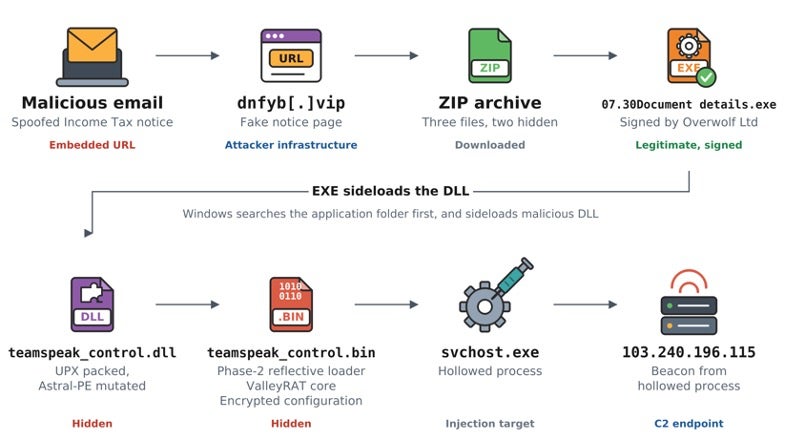
ValleyRAT kill chain (source: Forcepoint X-Labs).
The campaign begins with an email formatted as an official memorandum in both Hindi and English. That bilingual layout mirrors the style commonly used in Indian government correspondence, making the lure more credible.
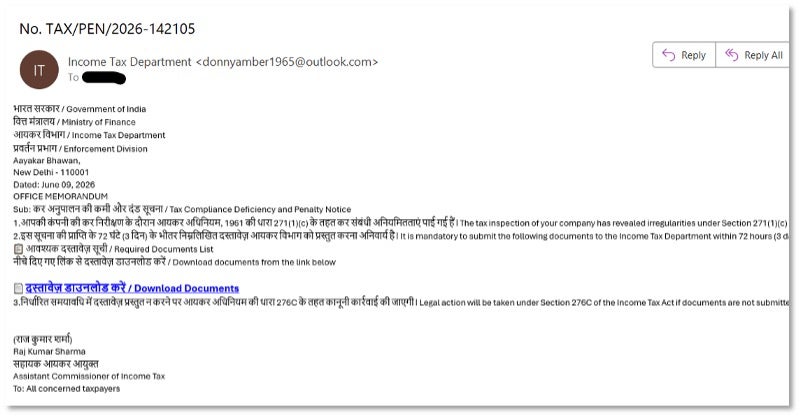
The lure email impersonating the Indian Income Tax Department (source: Forcepoint X-Labs).
The message cites Section 271(1)(c) for the alleged irregularity and threatens prosecution under Section 276C. Both are real provisions of Indian tax law, and their use strengthens the social-engineering narrative.
Forcepoint identifies two clear fraud indicators:
The display name reads "Income Tax Department", but the actual sender is a personal outlook.com address with no relationship to any
gov.innamespace.The message was delivered to a shared role mailbox rather than a named taxpayer. Clicking the embedded link opens
dnfyb[.]vip. The page displays the State Emblem of India and a forged Notice of Assessment, with three download buttons — all three deliver the same ZIP archive.
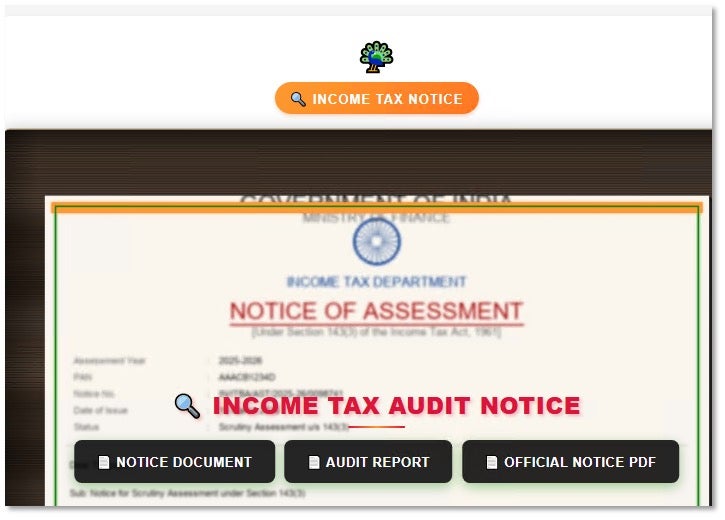
The staging page presenting a forged tax notice (source: Forcepoint X-Labs).
Three Files on Disk

Archive contents after extraction — only the executable is visible (source: Forcepoint X-Labs).
| File | Role |
|---|---|
07.30Document details.exe |
A clean, legitimately signed Overwolf Ltd executable, renamed. The only visible file in the extracted archive, and the one that side-loads the malicious DLL when executed |
teamspeak_control.dll |
The malicious loader, named to resemble a component of the legitimate executable. Reads and decrypts the accompanying .bin file |
teamspeak_control.bin |
The encrypted container holding the ValleyRAT core and configuration. No PE extension, no executable attribute |
Kill Chain
The victim receives the tax-themed lure email and clicks the link to
dnfyb[.]vip.A ZIP archive downloads containing three files, two of them hidden.
The victim runs
07.30Document details.exe— the validly signed Overwolf executable.That executable searches its own folder first when resolving DLL dependencies, and imports 18 specific functions from
teamspeak_control.dll, allowing the attacker-controlled DLL to load in the context of the signed process.The DLL takes its own module path, strips the extension and appends
.bin— the pairing is computed, not stored anywhere.The DLL reads
teamspeak_control.bin(298,544 bytes) and parses it as a sequence of length-prefixed records: each begins with a 4-byte length field followed by exactly that many bytes. The parser repeats until it reads a zero-length value. The file contains three records and is consumed completely, with no trailing data.Record 1 (3,992 bytes) is the Phase 2 reflective loader.
The loader reads the Record 2 size and requests exactly that much memory from Windows: 291,840 bytes.
Record 2 is copied into the allocated region while still encrypted, then decrypted into a header-stomped PE32+ DLL for AMD64 with five sections, ImageBase
0x180000000and SizeOfImage0x4B000.The loader copies headers and sections, applies relocations, resolves imports, calls the entry point with
DLL_PROCESS_ATTACH, then invokes the exportedrunfunction. The ValleyRAT core is never written to disk.Record 3 (2,696 bytes) is the encrypted configuration block, decrypted by Phase 3 using a five-byte key.
The RAT checks for administrator privileges; without them it terminates via
FatalExit.The RAT builds the staging path
C:\Program Files\Common Filesand copies all three original components there under the names in its configuration — the Overwolf executable becomes444.exe.All three dropped components are marked
-rhs-: read-only, hidden and system.Persistence is established through a scheduled task running at user logon, masquerading as a OneDrive entry.
The RAT hollows
svchost.exe, reconstructing the command lineC:\Windows\system32\svchost.exe -k netsvcsat runtime.The hollowed process establishes a TCP connection to the C2 at
103[.]240[.]196[.]115:1234.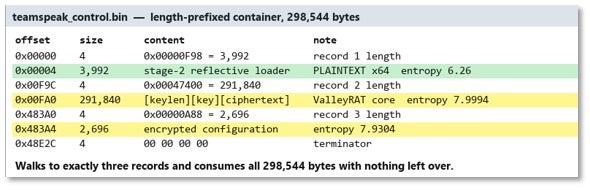
The three-record structure inside
teamspeak_control.bin(source: Forcepoint X-Labs).
Three Technical Details Worth Separating Out
The RC4 Key Is Also File-Format Metadata
This is the most refined piece of design in the campaign, and it deserves close reading by anyone writing detection rules.
Record 2 begins with a single byte, 0x73, representing a 115-byte key length. The next 115 bytes are the RC4 key, and the remainder is ciphertext.
When the reflective loader reassembles the payload in memory, the buffer layout is: length byte, key, then decrypted data. That layout places offset 0x3C inside the key — and in the PE format, offset 0x3C is where e_lfanew lives, the pointer to the real PE headers.
The four key bytes at that location are 38 01 00 00, which resolve little-endian to 0x138. That value points exactly to the payload's headers.
Offset 0x00     0x73 0x8F        keylen and key[0]. NOT "MZ"
Offset 0x3C     0x00000138       a valid e_lfanew, supplied BY THE KEY
Offset 0x138    0x00000000       where "PE\0\0" belongs. Zeroed.
Offset 0x13C    COFF FileHeader, machine 0x8664
The loader reads the 32-bit value at offset 0x3C with movsxd r14, [r15+3Ch], then add r14, r15 turns it into a pointer to the PE headers. The subsequent reads at [r14+50h] and [r14+30h] — SizeOfImage and ImageBase — confirm the loader treats it as a genuine Optional Header.
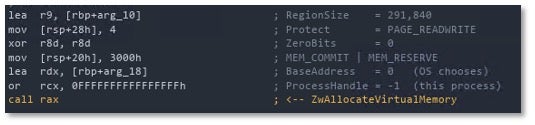
ZwAllocateVirtualMemory requesting exactly 291,840 bytes (source: Forcepoint X-Labs).
What this means for defenders: the in-memory payload has no "MZ" at its start and no "PE\0\0" at the conventional location. A memory scanner hunting PE headers by magic byte will walk straight past it. Part of the encryption key simultaneously serves as file-format metadata — and that is why the payload parses correctly despite both magic bytes being absent.
RC4 With One Line Changed
The cipher is RC4, but not stock RC4. One line of the algorithm has been altered.
Standard RC4 produces each keystream byte as S[(S[i] + S[j]) & 0xFF]. This sample instead uses S[i] XOR S[j].
It is a small change with a very concrete operational consequence: every standard RC4 decryption tool will return garbage. An analyst who has not read the code closely will conclude they extracted the wrong key or the wrong offset, and spend time re-deriving something that was already correct.
Two Keys, One Decryption Routine
The campaign uses a single decryption routine with two different keys:
A 115-byte key shipped inline within Record 2, for the 291 KB payload
A five-byte key
01 02 03 04 05compiled into the RAT, for configuration decryption
The five-byte configuration key materialised as two immediate operands (source: Forcepoint X-Labs).
The second key appears in two instructions: mov dword ptr [rbp+30], 0x04030201 writes the first four bytes, and mov byte ptr [rbp+34], 5 writes the fifth. Phase 3 calculates the source address from the two preceding record lengths, hardcodes the configuration size, copies the record into a fixed global buffer and decrypts it in place.
Forcepoint decrypted Record 3 offline using this five-byte key — meaning the campaign configuration is statically recoverable without executing the sample, a useful point for analysis teams.
The Administrator Check, and What It Means for Sandboxes
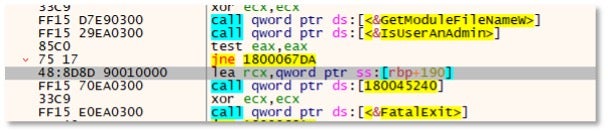
Execution terminates via FatalExit if the user lacks administrator privileges (source: Forcepoint X-Labs).
With the core loaded in memory and its configuration decrypted, ValleyRAT checks its privilege level before moving into persistence and evasion.
The RAT constructs a Windows SID with AllocateAndInitializeSid — likely for the local Administrators group — then calls CheckTokenMembership to test the current process token. A second path retrieves the module path and calls IsUserAnAdmin.
If the privilege check succeeds, execution continues. If it fails, the malware terminates through FatalExit.
This has a notable consequence for automated analysis workflows. It is not sandbox evasion in the classical sense — no VM fingerprint checks, no analysis process name lists, no execution delays. But the effect is equivalent: a sandbox running the sample under a standard user account will observe no malicious behaviour at all and may return a clean verdict.
If your triage process relies on automated sandbox results to classify samples, this is a specific reason to verify your analysis environment runs with appropriate privileges.
Persistence and the Final Stage
The decrypted Record 3 configuration shows the malware builds the staging directory path C:\Program Files\Common Files before accessing its dropped components.
Once running, the RAT copies all three delivery components — the signed Overwolf executable and its two companion files — from the original extraction folder into this staging directory, under the names specified in its configuration. The Overwolf executable becomes 444.exe.
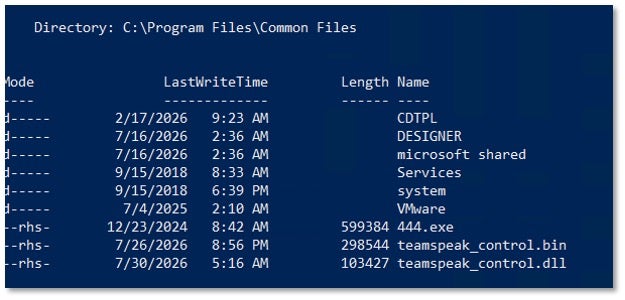
Dropped components marked read-only, hidden and system (source: Forcepoint X-Labs).
This second copy lets the kill chain restart from the staging location if needed. All three dropped components — 444.exe, teamspeak_control.dll and teamspeak_control.bin — are marked -rhs-.
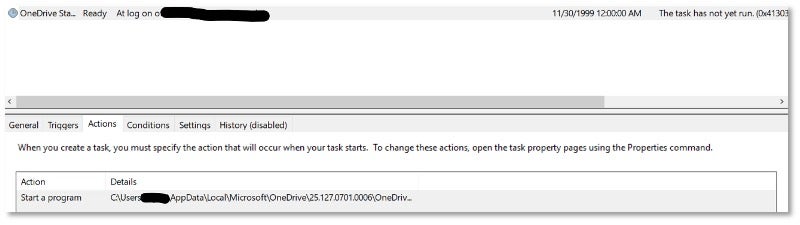
Scheduled task masquerading as a OneDrive entry, running at logon (source: Forcepoint X-Labs).
Persistence is achieved through a scheduled task configured to run at user logon, masquerading as a OneDrive entry, with an action that starts a program from a path under the user's local Microsoft OneDrive directory.
Finally the RAT performs process hollowing into svchost.exe, reconstructing the command line C:\Windows\system32\svchost.exe -k netsvcs at runtime. This lets it execute under the appearance of a legitimate Windows service host.
The hollowed process establishes a TCP connection to the C2 endpoint 103[.]240[.]196[.]115:1234 — unresponsive at the time of Forcepoint's analysis.
On Attribution: Three Distinct Levels
This needs careful presentation, because public sources do not agree on how far to attribute.
Forcepoint does not attribute this campaign to any group. The X-Labs report is purely technical analysis, describing the infection chain and components without naming an actor.
Foresiet, in an analysis published in July 2026, describes this same campaign — the same fake tax notice lure, the same three-file Overwolf/TeamSpeak sideloading kit, the same 18 tscontrol_* exports — and attributes it to Silver Fox, a China-nexus actor identified as the operator of the ValleyRAT (also known as Winos) backdoor.
ValleyRAT/Winos in general is linked to Silver Fox by multiple vendors in separate reporting.
We present these three levels separately rather than collapsing them into a single statement. For internal reporting, the safe formulation is: "the campaign deploys ValleyRAT; ValleyRAT is linked by multiple sources to Silver Fox; Forcepoint does not attribute this specific campaign."
A Discrepancy Between Sources Worth Noting
The two analyses describe the same campaign but differ on a technically significant detail:
| Item | Forcepoint (Aug 2026) | Foresiet (Jul 2026) |
|---|---|---|
| DLL characteristics | UPX-packed, Astral-PE mutated | ~30 MB |
| Final payload type | Native PE32+ AMD64, header-stomped | .NET / CLR |
| Loading mechanism | Reflective loading, PE32+ | Execution via the .NET runtime |
These are most likely two variants of the same campaign, analysed a month apart. The distinction matters practically for anyone writing detection: a rule anchored on .NET characteristics will miss the native variant, and vice versa. If you are building coverage for this campaign, account for both payload forms.
Indicators of Compromise
Indicators taken from the Forcepoint X-Labs report of 18 August 2026. Domains and IPs are defanged.
Note: Forcepoint publishes hashes as SHA-1, not SHA-256.
Primary files
62e3ba37a23669139a222cd43ec2b202277a4030    07.30Document details.exe
                                             Legitimate signed file abused for sideloading
f062e682ee38b33141ba03b17880b9cacca0e376    teamspeak_control.dll
                                             Malicious DLL executed via DLL sideloading
7de942da8993a45a5a7547de0a883f9b13f2f71c    teamspeak_control.bin
                                             Encrypted file holding the ValleyRAT core and config
Analysis artifacts (extracted by Forcepoint)
061f3e304c65f3f062f2aacc41b6d6f8a4f43816    Phase1_teamspeak_control_unpacked.dll
                                             Unpacked DLL, Astral-PE mutated
ab530af5603ce3f98b51b3c6f612074e020f572e    phase2_reflective_loader.bin   (Record 1)
d03fb03e8969e7ecbd763aa4bdc67a4629e19b10    payload_key_115bytes.bin       (Record 2 key)
2d830905581ae5c29d1e6bad27c6b63a097f79d7    phase3_config_encrypted.bin    (Record 3)
07846091fdeb1011cbd80d9ca45fd7dcb40b5c40    phase3_config_decrypted.bin    (Record 3, decrypted)
Staging URL and C2
dnfyb[.]vip                        Staging page delivering the ZIP
103[.]240[.]196[.]115:1234         C2, raw TCP
Other download domains in Forcepoint telemetry
This is where the campaign's real infrastructure scale shows — the same naming pattern across the
.vipTLD.
taobaoker[.]vip        kangyue[.]vip         wayaya[.]vip
cpxxw[.]vip            usheng[.]vip          yakin[.]vip
tanlianmeng[.]vip      nsseo[.]vip           dywwl[.]vip
rpaai[.]vip            kejiwei[.]vip         shhswz[.]vip
suoguan[.]vip          zbrhcggp[.]vip
On-host artifacts
# Staging directory
C:\Program Files\Common Files\444.exe                 Renamed Overwolf executable
C:\Program Files\Common Files\teamspeak_control.dll
C:\Program Files\Common Files\teamspeak_control.bin
  -> all three marked -rhs- (read-only, hidden, system)

# Persistence
Scheduled task at user logon, masquerading as a OneDrive entry,
action pointing to a path under the local Microsoft OneDrive directory

# Process hollowing
svchost.exe -k netsvcs   (command line reconstructed at runtime)
Technical artifacts usable for detection
# Imports
18 tscontrol_* functions imported from teamspeak_control.dll

# Record sizes within the .bin (298,544 bytes total)
Record 1    3,992 bytes      Phase 2 reflective loader
Record 2    291,840 bytes    Encrypted ValleyRAT core (with inline 115-byte key)
Record 3    2,696 bytes      Encrypted configuration (offset 0x483A4)

# Keys
0x73 + 115 bytes    Inline RC4 key for the payload
01 02 03 04 05      Hardcoded key for the configuration

# Algorithm variant
Modified RC4: S[i] XOR S[j] instead of S[(S[i] + S[j]) & 0xFF]

# In-memory payload characteristics
No "MZ" at offset 0x00
"PE\0\0" at offset 0x138 zeroed
e_lfanew at 0x3C sits inside the key, value 0x138
ImageBase 0x180000000, SizeOfImage 0x4B000, 5 sections, machine 0x8664
MITRE ATT&CK Mapping
| Tactic | Technique ID | Technique Name | Observed in campaign |
|---|---|---|---|
| Resource Development | T1583.001 | Acquire Infrastructure: Domains | 25+ domains on the .vip TLD |
| Initial Access | T1566.002 | Phishing: Spearphishing Link | Tax-themed email linking to the staging page |
| Execution | T1204.002 | User Execution: Malicious File | Victim runs the renamed Overwolf executable |
| Persistence | T1574.002 | Hijack Execution Flow: DLL Side-Loading | Signed EXE loading teamspeak_control.dll |
| Defense Evasion | T1036.005 | Masquerading: Match Legitimate Name or Location | EXE renamed as a document; OneDrive task; svchost -k netsvcs |
| Defense Evasion | T1027.002 | Obfuscated Files or Information: Software Packing | DLL packed with UPX |
| Defense Evasion | T1027 | Obfuscated Files or Information | Astral-PE header mutation; zeroed TimeDateStamp; mangled import names |
| Defense Evasion | T1140 | Deobfuscate/Decode Files or Information | Modified RC4 with two distinct keys |
| Defense Evasion | T1620 | Reflective Code Loading | Record 1 loads the ValleyRAT core entirely in memory |
| Defense Evasion | T1055.012 | Process Injection: Process Hollowing | Hollowing svchost.exe |
| Defense Evasion | T1564.001 | Hide Artifacts: Hidden Files and Directories | Hidden files in the archive; -rhs- attributes on dropped components |
| Persistence | T1053.005 | Scheduled Task/Job: Scheduled Task | Logon task masquerading as OneDrive |
| Discovery | T1069.001 | Permission Groups Discovery: Local Groups | CheckTokenMembership against the Administrators group |
| Discovery | T1033 | System Owner/User Discovery | IsUserAnAdmin |
| Command and Control | T1095 | Non-Application Layer Protocol | Raw TCP connection to C2 |
| Command and Control | T1571 | Non-Standard Port | Port 1234 |
| Command and Control | T1105 | Ingress Tool Transfer | ZIP download from the staging page |
| Exfiltration | T1041 | Exfiltration Over C2 Channel | ValleyRAT's C2 channel |
Assessment
Code signing was designed to answer "has this file been modified", not "what is this file about to do".
That is the campaign's central point, and it deserves stating plainly because it is not a flaw in the signing mechanism. The Overwolf executable in this chain is entirely intact. Its signature is valid because it genuinely is the file Overwolf signed. The attackers modified nothing — they simply placed another file next to it, exploiting entirely standard Windows behaviour: an executable resolves DLL dependencies from its own folder first.
Signature-based controls answer their question correctly. The problem is that it is not the question that needed answering here.
The best detection point is context, not file content. There is nothing in 07.30Document details.exe to detect. But there is a great deal in the circumstances of its appearance:
An Overwolf binary running from Downloads or Desktop, without the rest of an Overwolf installation around it
Overwolf is overlay software for PC gamers — it has no reason to appear on a finance or HR workstation
An executable spawning
svchost.exewith a-k netsvcscommand lineThree files sharing a base name with different extensions, sitting in
C:\Program Files\Common Fileswith-rhs-attributes None of these requires prior knowledge of a hash or a malware family name.
On removing local administrator rights. This is the most concrete argument I have seen in some time for a control usually discussed in the abstract. In an environment where users hold local admin rights, this chain runs all the way to C2. In an environment where they do not, the malware calls FatalExit and quits by itself. No EDR block required, no rule fired — it stops on its own.
The limit should be stated: this holds for the variant Forcepoint analysed. Another variant could add a low-privilege branch. But here, the control's effectiveness is observed rather than assumed.
On the payload with no magic bytes. The e_lfanew-inside-the-key detail is the kind of design that shows the authors understand both the PE format and how defensive tooling looks for it. For teams building memory-scanning detection the message is clear: scanning for "MZ" or "PE\0\0" magic bytes will miss this. What is catchable here is the allocation and mapping behaviour, not the content.
Relevance for Vietnam
Tax lures are universal, and this Indian version translates intact into a Vietnamese context.
Vietnam has the General Department of Taxation, the eTax and eTax Mobile systems, and an annual personal income tax finalisation season — everything needed to rebuild this exact scenario in Vietnamese. Two details from the Indian version stand out because neither depends on language or country:
Citing real legal provisions. The email cites Section 271(1)(c) and Section 276C — both genuine. A recipient who looks them up quickly will find they are real, and that raises credibility rather than lowering it. An equivalent Vietnamese version using provisions of the Law on Tax Administration is entirely feasible.
Delivery to a shared mailbox. Forcepoint cites this as a fraud indicator, but it is also a calculated targeting choice. Shared mailboxes such as ketoan@, hcns@ or info@ typically have no single accountable owner, rarely feature in awareness training, and are often accessed by several people using one set of credentials. In many organisations we encounter this is a near-unmonitored attack surface — and with a tax lure, the accounting mailbox is exactly where such an email should arrive, so it raises no suspicion.
A note on application catalogues. This chain works only because Windows loads DLLs from the executable's own directory. If your organisation runs application allowlisting, the question to ask is not "is Overwolf on the list" but "is this binary allowed to run from the Downloads folder". Many publisher-based allowlisting deployments would permit this exact chain, because the publisher genuinely is legitimate.
Recommendations
Remove local administrator rights from standard user accounts — in this chain, the absence of admin privileges causes the malware to terminate itself before establishing persistence or reaching C2.
Alert on validly signed binaries executing from Downloads, Desktop or temp directories without the rest of their installation present — particularly software outside your application catalogue.
Hunt two specific artifacts: files in
C:\Program Files\Common Filescarrying read-only + hidden + system attributes, and logon scheduled tasks masquerading as OneDrive entries.Block the 25
.vipdomains in the IOC list, and consider tighter monitoring of the.vipTLD generally if your organisation has no business need for it.Verify your sandbox environment runs with appropriate privileges — this sample terminates without admin rights, so a misconfigured sandbox will return a clean verdict on a malicious sample.
Bring shared mailboxes into awareness training and monitoring scope, assign a named owner to each, and consider stricter controls on attachments and links arriving in them.
References
Forcepoint X-Labs — Signed Overwolf Binary Sideloads ValleyRAT Malware in India Tax Scam, Raghu Ram (18 August 2026) — original report
Redmondmag — ValleyRAT Attack Turns Legitimate Windows App into a Malware Launcher (19 August 2026)
Foresiet — Fake Tax Notice Campaign: ValleyRAT Loader Unmasked (Part II) (July 2026) — analysis of the same campaign, with attribution
MITRE ATT&CK — T1574.002: DLL Side-Loading
MITRE ATT&CK — T1620: Reflective Code Loading
MITRE ATT&CK — T1055.012: Process Hollowing
Comments
Join the discussionNo comments yet. Be the first to comment.