Storm-1175, StormEncryptor and CVE-2026-18577: When the Patch Closes the Door and the Attacker Is Already Inside

Risk Summary
CVE-2026-18577 was disclosed on 2 August 2026. That same day, Microsoft Threat Intelligence observed Storm-1175 begin deploying a previously undocumented ransomware family: StormEncryptor. There was no gap between disclosure and exploitation.
But the most important point in this incident is not the speed. It is the sentence N-able put in bold in its own advisory: applying Hotfix 2 closes the vulnerability that allowed attackers in, but it does not remove a threat actor who may already be present in your environment. During the window customers spent waiting to patch, attackers were observed creating new accounts and resetting existing ones to maintain persistence.
And the target here is N-central — the remote monitoring and management platform managed service providers use to administer their customers' workstations. A compromised N-central server is not one victim. It is a list of victims.
Priority action: if you run N-central on-premise, upgrade to 2026.3.1.10 now — Hotfix 2 is required even if you already applied Hotfix 1. Then audit every account, regardless of what the IOC scanning tool returns.
The Two-CVE Chain and the Incomplete-Patch Lesson

This is not one vulnerability but two, and the relationship between them is the part that matters.
| Item | CVE-2026-18556 | CVE-2026-18577 |
|---|---|---|
| CVSS | 8.2 | 8.2 |
| Type | Authentication bypass, account takeover | Authentication bypass, account takeover |
| Relationship | Original CVE | Incomplete fix for CVE-2026-18556 |
| Patch | Hotfix 1 — 2026.3.1.7 (2 Aug) | Hotfix 2 — 2026.3.1.10 (6 Aug) |
| Affects | All N-central versions prior to 2026.3.1.7 | All versions prior to 2026.3.1.7 |
| CISA KEV | Added | Added 3 August |
The point to press: anyone who applied Hotfix 1 and stopped there remains exposed. N-able states plainly that this is not a duplicate communication, that Hotfix 2 is required even if the earlier hotfix was applied, and that Hotfix 2 supersedes Hotfix 1 with additional hardening measures.
This is a pattern operations teams should internalise for similar incidents. When a vendor ships an emergency hotfix while a threat actor is still active, the first patch is typically written under time pressure and targets the specific attack path observed — not the whole vulnerability class. Treating that first hotfix as the end point, rather than the start of a monitoring cycle, is where many organisations lose the most time.
Timeline
| Date | Event |
|---|---|
| 31 Jul 2026 | N-able's own Adlumin MDR solution detects unusual activity inside a customer environment and identifies a threat actor exploiting a then-unknown N-central vulnerability |
| 1 Aug 2026 | N-able issues first public guidance and upgrade recommendation; registers the first CVE (CVE-2026-18556) |
| 2 Aug 2026 | Second CVE registered (CVE-2026-18577); Hotfix 1 (2026.3.1.7) released; mitigation deployed to hosted environments; customers notified directly |
| 2 Aug 2026 | Microsoft observes Storm-1175 begin deploying StormEncryptor |
| 3 Aug 2026 | CISA adds CVE-2026-18577 to the Known Exploited Vulnerabilities catalog |
| 6 Aug 2026 | Continued monitoring surfaces a related attack path; Hotfix 2 (2026.3.1.10) released the same day |
| 7 Aug 2026 | Microsoft Threat Intelligence publishes its StormEncryptor advisory on Bluesky and X |
| 10 Aug 2026 | N-able publishes a detailed update with a full timeline and expanded IOC list |
One point worth crediting on the vendor side: N-able detected the incident itself using its own MDR product, and it stated its reason for saying so directly — not for recognition, but because it is evidence that layered, continuous security monitoring works. It is also why they were able to respond as fast as they did.
On transparency, N-able also explains why it has withheld technical specifics: releasing detailed technical information while threat actors are still active gives them information they can use. The company has committed to publishing a full root cause analysis when it is safe to do so. For a TI team the implication is worth noting: the current technical picture is incomplete, and further indicators will emerge.
The Observed Attack Chain
The attacker exploits a vulnerability in N-central allowing remote administrative access without authentication.
With administrative access, they use N-central's own Take Control feature to connect to systems within the N-central managed environment.
On those devices, they register a new Cloudflare Tunnel service.
That service maintains persistence even after access to the N-central server is revoked.
Within the N-central environment, they create new user accounts and reset existing user passwords to hold their foothold.
On reached devices, they deploy RMM tooling — AnyDesk or SimpleHelp — as an alternative control channel.
They use Advanced IP Scanner for network discovery.
They use Mimikatz to dump credentials from the LSASS process.
They exfiltrate data, then deploy StormEncryptor across the environment.
Take Control: A Legitimate Feature as the Springboard
Step 2 deserves separate attention, because it determines the blast radius.
Take Control is not a vulnerability. It is the remote access feature every MSP technician uses daily to support customer workstations. Once the attacker holds administrative rights on N-central, they need to exploit nothing further to reach customer endpoints — they simply use the function designed for exactly that purpose.
This changes the nature of the defensive problem at the end customer. On the endpoint of a small business under MSP management, a Take Control session is entirely normal activity and generates no alert. What distinguishes a legitimate session from an attacker's is not the tool but the timing, the initiating account, and what happens after the session.
Cloudflare Tunnel: Persistence That Outlives the Entry Point
Steps 3 and 4 are architecturally notable. A Cloudflare Tunnel creates an outbound connection from the victim device to Cloudflare infrastructure, meaning it needs no inbound open port, traverses NAT and firewalls like ordinary web traffic, and does not depend on whether N-central remains compromised.
The direct consequence for incident response: patching N-central and revoking the attacker's access to that server does not cut this channel. The tunnel is already on the endpoint, registered as a service, and continues operating independently.
An observation of ours, at moderate confidence. Microsoft's April 2026 Storm-1175 actor profile documents the group's regular use of Cloudflare tunnels renamed to mimic legitimate binaries such as
conhost.exefor lateral movement over RDP and payload delivery. N-able's IOC list for this incident includes a registered service named "Cloudflared" and a file namedsvchost.exein a user's Documents directory. The two sources do not connect to each other, but the pattern matches closely: a Cloudflare tunnel used for persistence, plus a masqueraded system binary placed in an anomalous location. This is corroborating evidence for Microsoft's attribution of this activity to Storm-1175, even though Microsoft itself states the initial access vector is unconfirmed. No source in this material asserts that link; verify independently before using it in formal reporting.
Storm-1175 Actor Profile
Storm-1175 is a financially motivated cybercriminal group. The Hacker News and BleepingComputer describe it as China-linked, citing Microsoft reporting from 2024; Microsoft's own April 2026 profile blog describes it only as a "financially motivated cybercriminal actor" without naming a country in the body text. We preserve that distinction rather than collapsing it.
Operating Model: High-Velocity N-Day Exploitation
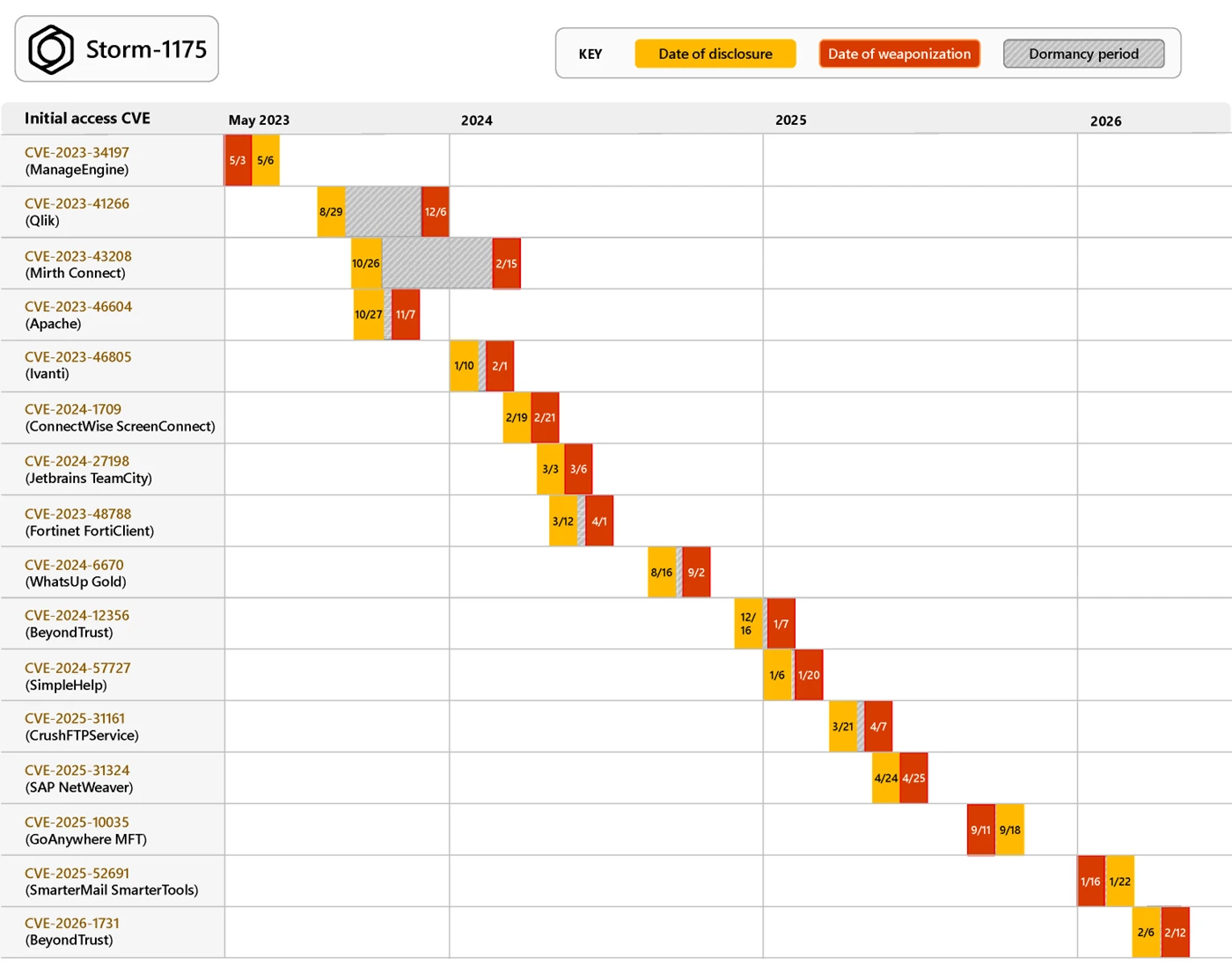
Timeline of disclosure and weaponization for vulnerabilities used by Storm-1175 (source: Microsoft Threat Intelligence).
The group's defining characteristic is weaponizing recently disclosed vulnerabilities against internet-facing systems during the window between vulnerability disclosure and widespread patch adoption.
Since 2023, Microsoft has observed Storm-1175 exploiting more than 16 vulnerabilities:
CVE-2023-21529                    Microsoft Exchange
CVE-2023-27350, CVE-2023-27351    PaperCut
CVE-2023-46805, CVE-2024-21887    Ivanti Connect Secure / Policy Secure
CVE-2023-37679, CVE-2023-43208    Mirth Connect
CVE-2023-48788                    Fortinet FortiClient EMS
CVE-2024-1708, CVE-2024-1709      ConnectWise ScreenConnect
CVE-2024-27198, CVE-2024-27199    JetBrains TeamCity
CVE-2024-57726/57727/57728        SimpleHelp
CVE-2025-31161                    CrushFTP
CVE-2025-10035                    Fortra GoAnywhere MFT
CVE-2025-52691, CVE-2026-23760    SmarterTools SmarterMail
CVE-2026-1731                     BeyondTrust
On speed, two figures say everything:
SAP NetWeaver CVE-2025-31324 was disclosed on 24 April 2025. Microsoft observed Storm-1175 exploiting it on 25 April — one day later.
The group has used at least three zero-days. Among them, CVE-2026-23760 (SmarterMail) and CVE-2025-10035 (GoAnywhere MFT) were exploited a full week before public disclosure. Microsoft assesses this as evidence of evolved development capability or new access to resources such as exploit brokers — while also noting that GoAnywhere MFT had previously been targeted by ransomware attackers, and that the SmarterMail vulnerability was reportedly similar to a previously disclosed flaw, factors that may have facilitated the zero-day activity.
On operational tempo: from initial access to ransomware deployment typically takes five to six days, and in some cases under 24 hours.
Post-Compromise Toolkit
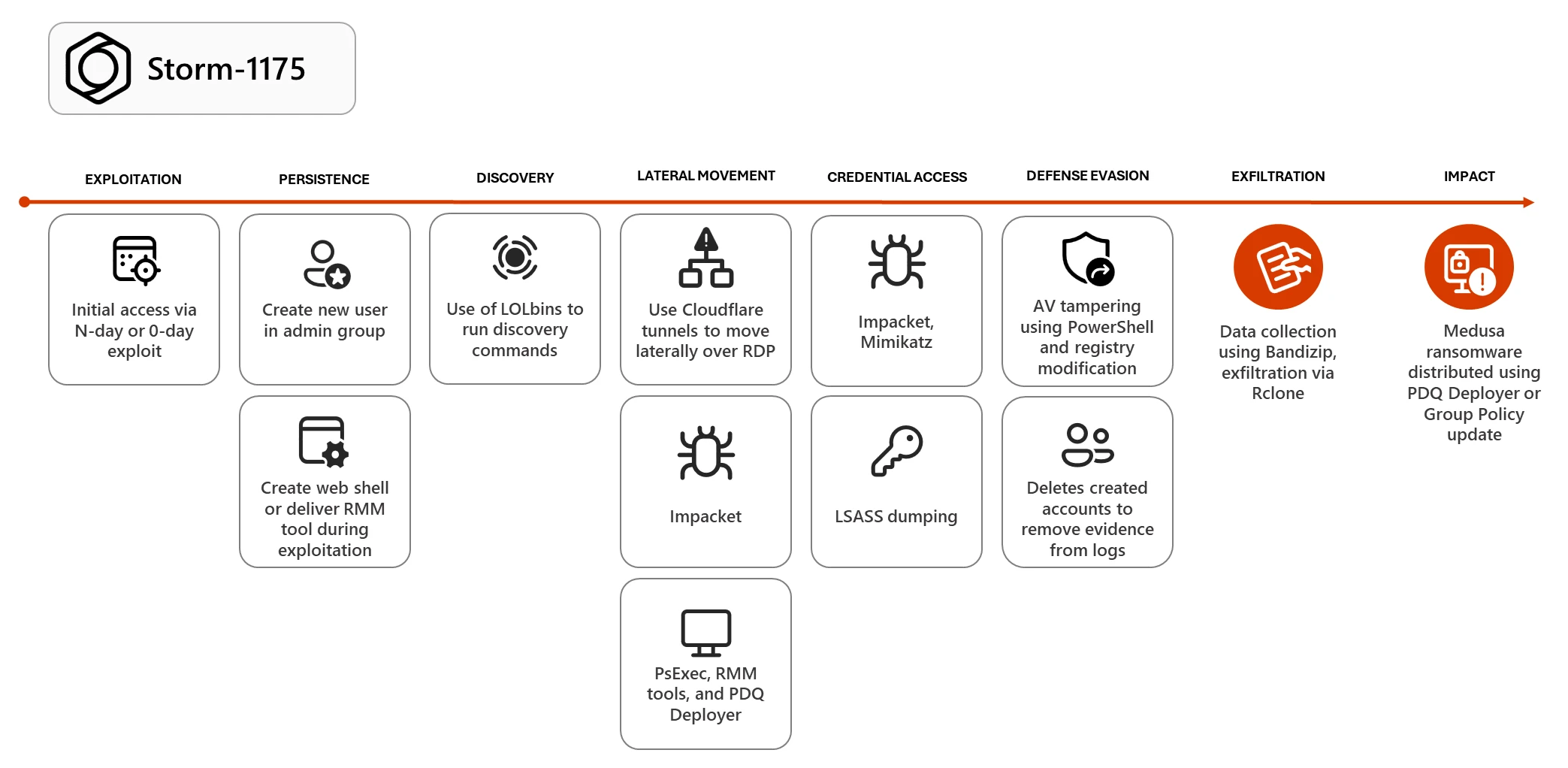
The Storm-1175 attack chain from exploitation to impact (source: Microsoft Threat Intelligence).
From Microsoft's April 2026 profile, the group's full toolkit and technique set:
Persistence and lateral movement. Creating new user accounts and adding them to the administrators group. Living-off-the-land binaries — PowerShell and PsExec — as the base, plus Cloudflare tunnels renamed to mimic legitimate binaries for movement over RDP. If RDP is not allowed in the environment, the group uses administrative privileges to modify the Windows Firewall policy to enable Remote Desktop. Impacket is used for lateral movement.
RMM abuse. Since 2023, Storm-1175 has used multiple RMM platforms: Atera, Level RMM, N-able, DWAgent, MeshAgent, ConnectWise ScreenConnect, AnyDesk, SimpleHelp. The group also relies heavily on PDQ Deployer — a legitimate software deployment tool letting administrators silently install applications — for both lateral movement and payload delivery.
A pointed irony here: N-able appears on the list of RMM tools Storm-1175 abuses as post-compromise tooling, predating its exploitation of N-central as an entry point. The group knows this platform in both roles.
Credential theft. Impacket and Mimikatz for LSASS dumping. Living-off-the-land techniques: modifying the UseLogonCredential registry entry to re-enable WDigest credential caching, or using Task Manager to dump LSASS. With administrator credentials, the group has used a script to recover passwords from Veeam backup software to connect to remote hosts. With sufficient privileges, PsExec is used to pivot to a Domain Controller for access to NTDS.dit and the SAM hive.
Defense tampering. Modifying Microsoft Defender Antivirus settings in the registry. Using encoded PowerShell commands to add the C:\ drive to the antivirus exclusion path, preventing the whole drive from being scanned.
Exfiltration and ransomware deployment. Using Bandizip to collect files and Rclone for exfiltration — the sync tool allows large volumes to move to attacker-owned cloud resources while continuously syncing new files throughout every stage of the attack without attacker interaction. Finally, using PDQ Deployer to launch a script named RunFileCopy.cmd and deliver ransomware payloads across the network; in some cases the group has instead used privileged access to create a Group Policy update for broad deployment.
Prior victimology. Recent intrusions heavily impacted healthcare organisations, along with education, professional services and finance sectors in Australia, the United Kingdom and the United States.
StormEncryptor
The move to StormEncryptor marks Storm-1175's first activity observed by Microsoft since April 2026, and a shift away from Medusa, the ransomware family the group had previously been known for.
| Property | Detail |
|---|---|
| Language | C++ |
| Encrypted file extension | .encrypted |
| Ransom note | !!!README_FIRST!!!.txt, dropped to every scanned directory |
| Note content | Gives victims three days to make contact and negotiate, or stolen data is published |
| Model | Double extortion |
| Detection | Ransom:Win64/StormEncryptor (Microsoft Defender Antivirus) |
The significance of leaving Medusa is worth weighing. Medusa is a ransomware-as-a-service offering with a shared leak site serving many affiliates. StormEncryptor is a custom payload. The shift means the group has moved from renting infrastructure to building it, and the direct defensive consequence is that every detection keyed on Medusa signatures — Ransom:Win32/Medusa, for instance — no longer catches this group. If your playbook ties Storm-1175 to Medusa, that playbook went stale on 2 August.
Indicators of Compromise
Compiled from N-able's N-central update of 10 August 2026, the Microsoft Threat Intelligence advisory of 7 August 2026, and Microsoft's April 2026 Storm-1175 profile. IPs are defanged.
IP addresses (source: N-able, 10 August update)
173.249.252[.]200
185.156.46[.]150
23.234.94[.]43
37.153.90[.]88
37.19.210[.]32
68.235.46[.]214
68.235.46[.]235
87.249.138[.]34
92.118.112[.]181
Note on a source discrepancy: The Hacker News' 8 August report lists ten addresses, adding
173.249.252[.]176alongside the nine above. N-able's 10 August update lists only nine. We retain both and recommend including173.249.252[.]176in blocklists, since it sits in the same/24as a confirmed address.
On-host artifacts (source: N-able)
# File
svchost.exe            located in a user's Documents directory
                       (masqueraded system binary in a location that is never legitimate)

# Service
Cloudflared            service registered for a Cloudflare Tunnel

# Behaviour to review
- Unusual Take Control activity or unauthorized actions on managed endpoints
- Suspicious logins to the N-central server
- Unexpected creation of new users
- Unexplained user password resets
StormEncryptor (source: Microsoft Threat Intelligence)
SHA-256      c19ded65e822bb43ad0381c58abf33b7c8890f7bcc7125058a0c849c7e1a6054
Detection    Ransom:Win64/StormEncryptor
Ransom note  !!!README_FIRST!!!.txt
Extension    .encrypted
Indicators from 2026 Storm-1175 attacks (source: Microsoft, April 2026)
# File hashes (SHA-256)
0cefeb6210b7103fd32b996beff518c9b6e1691a97bb1cda7f5fb57905c4be96   Gaze.exe (Medusa)
9632d7e4a87ec12fdd05ed3532f7564526016b78972b2cd49a610354d672523c   lsp.exe (Rclone) *
e57ba1a4e323094ca9d747bfb3304bd12f3ea3be5e2ee785a3e656c3ab1e8086   main.exe (SimpleHelp)
5ba7de7d5115789b952d9b1c6cff440c9128f438de933ff9044a68fff8496d19   moon.exe (SimpleHelp)

* Microsoft notes this hash has also appeared in ransomware intrusions by other
  threat actors since 2024 — do not treat it as a Storm-1175-specific indicator

# SimpleHelp C2 IPs
185.135.86[.]149
134.195.91[.]224
85.155.186[.]121
Affected versions and patches
Affected      All N-central versions prior to 2026.3.1.7
Hotfix 1      2026.3.1.7   (2 Aug 2026) — NOT sufficient
Hotfix 2      2026.3.1.10  (6 Aug 2026) — required, supersedes Hotfix 1
Microsoft Defender for Endpoint alert names usable immediately
Hands-on-keyboard attack involving multiple devices
Potential human-operated malicious activity
Ransomware-linked threat actor detected
New local admin added using Net commands
Suspicious PowerShell download or encoded command execution
Renaming of legitimate tools for possible data exfiltration
Attempt to turn off Microsoft Defender Antivirus protection
Remote access software
Vendor-supplied tooling
N-able has released a custom service template that automatically checks for known IOCs against Windows endpoints in N-central. Their own caveat matters: a clean result is not a guarantee that your environment was not impacted; the investigation is ongoing and additional indicators may be identified over time. It should be one layer of your assessment alongside a thorough review of your environment, logs and account activity.
MITRE ATT&CK Mapping
| Tactic | Technique ID | Technique Name | Observed in campaign |
|---|---|---|---|
| Initial Access | T1190 | Exploit Public-Facing Application | Exploiting the N-central authentication bypass |
| Persistence | T1136.001 | Create Account: Local Account | New accounts created on N-central and on endpoints |
| Persistence | T1098 | Account Manipulation | Resetting existing user passwords |
| Privilege Escalation | T1078 | Valid Accounts | Administrative accounts obtained via account takeover |
| Command and Control | T1572 | Protocol Tunneling | Cloudflare Tunnel service registered on endpoints |
| Command and Control | T1219 | Remote Access Software | AnyDesk and SimpleHelp as alternative control channels |
| Lateral Movement | T1021.001 | Remote Services: Remote Desktop Protocol | Lateral movement over RDP |
| Defense Evasion | T1562.004 | Impair Defenses: Disable or Modify System Firewall | Modifying Windows Firewall to enable RDP |
| Defense Evasion | T1562.001 | Impair Defenses: Disable or Modify Tools | Adding C:\ to AV exclusions; Defender registry tampering |
| Defense Evasion | T1112 | Modify Registry | Defender settings; UseLogonCredential |
| Defense Evasion | T1036.005 | Masquerading: Match Legitimate Name or Location | svchost.exe in Documents; tunnels renamed to conhost.exe |
| Credential Access | T1003.001 | OS Credential Dumping: LSASS Memory | Mimikatz, Impacket |
| Credential Access | T1003.003 | OS Credential Dumping: NTDS | NTDS.dit access on the Domain Controller |
| Credential Access | T1555 | Credentials from Password Stores | Veeam password recovery script |
| Discovery | T1046 | Network Service Discovery | Advanced IP Scanner |
| Discovery | T1018 | Remote System Discovery | Enumerating systems in the managed environment |
| Execution | T1072 | Software Deployment Tools | PDQ Deployer running RunFileCopy.cmd |
| Execution | T1059.001 | PowerShell | Encoded PowerShell for AV configuration changes |
| Impact | T1484.001 | Domain or Tenant Policy Modification: Group Policy | GPO used for broad ransomware deployment |
| Collection | T1560.001 | Archive Collected Data: Archive via Utility | Bandizip |
| Exfiltration | T1567.002 | Exfiltration to Cloud Storage | Rclone |
| Impact | T1486 | Data Encrypted for Impact | StormEncryptor deployment |
| Impact | T1657 | Financial Theft | Double extortion |
Relevance for Vietnam
The risk here propagates, and that is the biggest difference from an ordinary vulnerability. Outsourced IT is common among Vietnamese small and medium businesses, and N-central is among the RMM platforms service providers use.
The direct consequence: an organisation can be affected without knowing it sits behind somebody's N-central server. You do not run N-central, you receive no notification from N-able, you are not on the affected customer list — but the agent on your workstations still takes instructions from a server you neither control nor see.
The practical questions to put to your IT service provider, and to put in writing:
Which RMM platform do you use to manage our machines?
If it is N-central, have you applied Hotfix 2 (2026.3.1.10), and on what date?
Is MFA enabled across all accounts on that platform?
Between 31 July and the date you patched, was there any unusual Take Control activity on our devices? These are questions most domestic IT service contracts contain no clause obliging the provider to answer. This incident is a very specific reason to add them at the next renewal.
One small operational item worth doing now. N-able recommends disabling the in-product support account unless required for an open support issue. This is the class of account that exists in most administrative platforms, gets enabled once for one issue and never disabled again, and almost never falls within periodic account review scope. It was not a vector in this campaign, but it is exactly the kind of asset a group like Storm-1175 looks for.
Recommendations
Upgrade N-central to 2026.3.1.10 immediately — Hotfix 2 is required even if Hotfix 1 was applied, because Hotfix 1 addressed only the original access point.
If you patched more than a few days after release, treat the environment as compromised: review all user accounts, access privileges and activity history, and do not treat a clean IOC scan result as a conclusion.
Hunt for two specific endpoint artifacts: a file named
svchost.exein a user's Documents directory, and a registered service namedCloudflared— neither has any legitimate use case.Take the N-central administrative interface off the public internet: place it behind a VPN or reverse proxy, enforce MFA on all accounts, and disable the in-product support account when no ticket is open.
If you are an MSP customer: ask in writing which RMM platform they use, the date they applied Hotfix 2, and whether any unusual Take Control activity occurred on your devices between 31 July and their patch date.
Standardise detection on behaviour, not ransomware family: Storm-1175 swapped Medusa for StormEncryptor while keeping its post-compromise TTPs intact — alerts on local admin creation, LSASS dumping, AV exclusion changes and renamed legitimate tools remain the most effective catch points.
References
Microsoft Threat Intelligence — Advisory on Storm-1175 and StormEncryptor, Bluesky (7 August 2026)
Microsoft Threat Intelligence — Storm-1175 focuses gaze on vulnerable web-facing assets in high-tempo Medusa ransomware operations (6 April 2026) — the most detailed TTP profile
The Hacker News — China-Linked Hackers Deploy New StormEncryptor Ransomware, Likely via N-central Flaw (10 August 2026)
The Hacker News — N-able Issues N-central Hotfix 2 as Attackers Reach Managed Systems and Persist (8 August 2026)
N-able — N-central Security Update, August 10, 2026 — full timeline and expanded IOCs
N-able — Hotfix 2 for CVE-2026-18577
N-able — IOC detection service template
BleepingComputer — New StormEncryptor ransomware used by former Medusa affiliate
GBHackers — Storm-1175 Launches StormEncryptor Ransomware Attacks Using N-able Security Flaw
MITRE — CVE-2026-18577